West Asia Regional
Study
on the Experience in the Development of Environmental Data
and Information
Systems
2006
Disclaimers
The
contents and views expressed in this publication do not necessarily reflect the
views or policies of the agencies cooperating in this project.
The
opinions, figures and estimates set forth in this publication should not
necessarily be considered as reflecting the view or carrying the endorsement of
UNEP or cooperating agencies.
The
designations employed and the presentation of material in this publication do
not imply the expression of any opinion whatsoever on the part of UNEP or cooperating agencies concerning the legal
status of any country, territory or city or area of its authorities, or the
delineation of its frontiers and boundaries.
Mention
of a commercial company or product in this publication does not imply the
endorsement of the United Nation Environment Programme or cooperating agencies.
The
use of information from this publication concerning proprietary products for
publicity or advertising in not permitted. Trademark names and symbols are used
in an editorial fashion with no intention of infringement on trademark or
copyright laws
We
regret any errors or omissions that may have been unwittingly made.
Acknowledgements
UNEP
acknowledges the contributions made by many individuals and institutions in the
preparation of this document. A special word of thanks goes to the Environment
Agency Abu Dhabi and AGEDI for providing the funding for this project and for
reviewing the document. We acknowledge with thanks the work done by CEDARE on
integrating the national and regional reports into the integrated AGEDI
regional Study. Our thanks are also extended to ECODIT Liban for implementing
the integration of the reports as a consultant to CEDARE. Our special thanks go
to the encouragement and support provided by Mr. Majid
Al-Mansouri, Secretary General of the Environment Agency of Abu Dhabi, and Dr. Habib Elhabr, Director and Regional
Representative, UNEP Regional Office of West Asia. We are also thankful for the
support given by Dr. Jaber E. Al-Jabri, Director of Environmental
Protection Division, EAD.
The full list of names to acknowledge is
given below.
Production
and Support Team
Regional Coordination:
Adel Farid Abdel-Kader (UNEP-DEWA West Asia)
Integrated study, CD and
Web Production:
Hossam Allam (CEDARE)
Ahmed Abdel-Rehim (CEDARE)
Environment Agency Abu Dhabi Review Team:
Mohammad Al Jawdar, Anil Kumar, Yasser R.
Othman, Jane C. Glavan, Ahlam A. Al Marzouqi
Support Team:
Matthew C. Broughton and Hiba Sadaka
(UNEP-DEWA West Asia), Youssef EL-Maraghy and Hisham
Hamdy (CEDARE), Nicole A. Stephanou (EAD)
Authors
Lead
Author:
Karim El-Jisr (ECODIT Liban)
Contributing
Authors:
Regional
Integrated Report:
Saud Amer (USGS)
National Reports:
Abdul Nabi Al-Ghadban (Kuwait, Kuwait
Institute for Scientific Research), Ahmad Thaljij Qatarneh (Jordan, Ministry of
Environment), Ahmed Salem Muskat (Yemen, Environment Protection Authority, Ministry
of Water and Environment), Ahsanullah Khan (Saudi Arabia, Presidency of
Meteorology and Environment), Anil Kumar (United Arab Emirates, Environment
Agency Abu Dhabi), Jamalat Hassan Abdo Ali Al-Aghbari (Yemen, Ministry of Water
& Environment, Environment Protection Authority), Karim El-Jisr (Lebanon, ECODIT
Liban), Mohammed bin Saif Al-Kalbani (Oman, Ministry of Regional
Municipalities, Environment and Water Resources), Moheed Abd El-Sattar Ebrahim
(Egypt, Egyptian Environmental Affairs Agency), Naim Mahmoud Al-Khatib (Occupied
Palestinian Territories, Environmental Quality Authority), Sayed Jamal Bukhari
and Mubarak Khalifa Al-Dosari (Qatar, Supreme Council for the Environment and
Natural Reserves), Waleed K. Al-Zubari (Bahrain, Arabian Gulf University), Yahia
Awaidah (Syria, Consultants for Sustainable Development)
Regional Reports:
Abdallah Droubi (ACSAD), Ahmed Abdel Rehim
(PERSGA), Hossam Allam (CEDARE), Mohammed Ait Belaid (Arabian Gulf University)
Participants of the Regional Meeting on
Experiences & Best Practices in Environmental Information Development &
Management in West Asia, 9 – 10 January 2005, Abu Dhabi, U.A.E
Dr. Abdul Nabi Al-Ghadban, Dr. Abdulbasit S.
Sairafi, Mr. Abdul Aziz Abdulla Al-Midfa, Eng. Abdulla Ali Al-Danhani, Eng.
Abdul Rahman Al-Marzouqi, Mr. Abdalla Essa Zamzam, Dr. Abdullah Droubi, Dr.
Adel F. Abdel Kader, Eng. Adel Mohamed Al-Hajeri, Mr. Ahmad Mahmoud Mohammad
Said, Dr. Ahsanullah Khan, Mr. Ahmed Salem Mulkat, Mr. Ahmed Abdel Rehim, Dr.
Ahmed Gamal Atalla, Mr. Anil Kumar T. P., Mr. Ateeq Khalfan Al-Muhairi, Dr.
Dessougi L. A., Mr. Dave MacDevette, Ms. Entesar Ahmed Al-Hosani, Eng. Faisal
Ali Al-Hammadi, Eng. Firas Asfour, Mr. Hanna Nasr, Mrs. Habiba Al-Marashi, Dr.
Habib El-Habr, Mr. Habib Zaatar, Eng. Hazem H. Qawasmeh, Mrs. Hiba Sadaka, Eng.
Ibrahim Ahmed Khuluti, Mr. Jaap van Woerden, Dr. Jaber E. Al-Jabri, Ms. Jane
Glavan, Mr. Karim El-Jisr, Ms. Leila Y. Al-Hassan, Mr. Majid Al-Mansouri, Mr.
Mazen Malkawi, Mr. Mansour S. Al-Falasi, Mr. Mohammed El-Hafiz Abdulwahid
Ahmed, Mr. Mohammed Abel Hamyd Dawoud, Mr. Mohammed Y. Al-Jawdar, Eng. Mohamed
M. K. Al-Mehairy, Dr. Mohammed Ait Belaid, Dr. Mohammed Abido, Dr. Mohammed
Al-Aawah, Mr. Mohammed bin Saif Al-Kalbani, Eng. Moheeb Abdl-Sattat Ebrahim,
Mr. Mubarak Khalifa Al-Dosari, Dr. Mufeed Odeh, Mrs. Nicole Stephanou, Dr.
Rafic Z. Makki, Mrs. Sabah Al-Jenaid, Dr. Salem Al-Dhaheri, Mrs. Shahira Wahbi,
Mrs. Suhad H. Al-Shehabi, Mr. Tarek Mahmoud Mohamed Ibrahim,.A.E, Mr. Volodymyr
Demkine, Mr. Yassin Ramahi, Mr. Jaap.van.Woerden.
Table of Content...................................................................................................................................................... Page
Executive
Summary.. v
1. INTRODUCTION... 1
1.1. Background.. 1
1.2. Purpose.. 1
1.3. Methodology.. 2
1.4. Report Organization.. 2
2. ENVIRONMENTAL DATA AND INFORMATION in West asia.. 4
2.1. Analysis of current situation regarding environmental data.. 4
2.2. Data and Information Availability.. 6
2.3. Public Access. 12
2.4. Information Policy and Legislation.. 12
2.5. Institutional Capacity for Managing Environmental Data and Information 13
2.6. Financing of environmental data and information.. 14
3. Effectiveness and
efficiency of current information systems. 17
3.1. Strengths. 12
3.2. Weaknesses. 12
4. Constraints and barriers to improve
ENVIRONMENTAL DATA AND INFORMATION... 19
4.1. Disclosure/Confidentiality.. 19
4.2. ICT Infrastructure & Internet Connectivity.. 20
4.3. Data Consolidation/Storage.. 21
4.4. Funding.. 21
4.5. Bureaucracy.. 21
5. ENVIRONMENTAL DATA NEEDS TO SUPPORT SUSTAINABLE
DEVELOPMENT.. 22
5.1. Environmental priority issues. 22
5.2. Environmental information needs to support decision-making.. 22
5.3. Technological needs. 23
5.4. Institutional needs. 24
5.5. Using Environmental Data to support decision making in West Asia.. 25
6. REGIONAL AND
INTERNATIONAL COOPERATION... 25
7. LESSONS LEARNED &
OPPORTUNITIES FOR THE FUTURE.. 31
8. Recommended priority
actions. 33
8.1. Policy.. 33
8.2. Institutional. 33
8.3. Technical. 34
8.4. Financial. 35
List of Tables ............................................................................................................................ Page
Table 1 Indicative List of Environmental Databases
in West Asia Countries 8
Table 2 Central Institutions Handling Environmental
Information in West Asia. 15
Table 3 Ranking
of West Asia Countries with Respect to
Maturity Levels of ICT Infrastructure. 20
Table 4 Environmental priority issues by country. 22
Table 5 Type of Internet Services in West Asia. 23
List of
Figures
........................................................................................................................... Page
Figure 1 Number of Internet Users in West Asia
Countries 24
Figure 2 Number of Personal Computers in West Asia
Countries 24
Figure 3 Echelons of the Information Hierarchy. 32
List of Boxes.............................................................................................................................. Page
Box 1 Environmental Information Systems in West
Asian countries .................................................................. 4
Box 2 Regional Organization for the Conservation
of the Environment of the Red Sea and Gulf of Aden
– Overview of Regional Activities................................................................................................................................................................................. 30
List of Appendices
Appendix A Authors
of National and Regional Reports on Environmental Information & Databases
Appendix B Tasks
included in the Terms of Reference
Appendix C Cited
References, Websites and Consultations
Appendix D Glossary
of Internet Services
List of Acronyms and Abbreviations
|
AEF
|
Arab Environment Fund
|
|
AEIN
|
African Environment Information Network
|
|
AGEDI
|
Abu Dhabi Global Environmental Data Initiative
|
|
AGU
|
Arabian Gulf University
|
|
ALECSO
|
Arab League
Educational, Cultural and Scientific Organization
|
|
ASCAD
|
The Arab
Center for the Studies
of Arid Zones and Dry Lands
|
|
ASDL
|
Asymmetric Digital Subscriber Line
|
|
BCSR
|
Bahrain Center for Studies and Research
|
|
CEDARE
|
Center for Environment and Development in the Arab
Region and Europe (Egypt)
|
|
CIDA
|
Canadian International Development Agency
|
|
CIESIN
|
Center
for International Earth Science Information Network
|
|
DAP
|
Arab
Data bank for Arid Plants
|
|
DPSIR
|
Driving
Force State Impact Response
|
|
DSS
|
Decision Support Systems
|
|
EAD
|
Environment Agency Abu Dhabi, formerly “Environment Research
and Wildlife Development Agency”
|
|
EDMRAS
|
Environmental
Data Management, Reporting and Assessment System
|
|
EEAA
|
Egyptian Environmental Affairs Agency (Egypt)
|
|
EEIS
|
Egyptian
Environmental Information System
|
|
EIS
|
Environmental Information System
|
|
EPA
|
Environment
Public Agency (Kuwait)
|
|
EQA
|
Environment Quality Authority (Occupied Palestinian Territories)
|
|
ERWDA
|
Environment Research and Wildlife Development Agency
(UAE)
|
|
ESCWA
|
Economic and Social Commission for Western Asia (Lebanon)
|
|
ESIS
|
ESCWA Statistics Information System
|
|
FAO
|
Food
and Agriculture Organization
|
|
GEO
|
Global Environment Outlook
|
|
GTZ
|
German Agency for Technical Cooperation
|
|
GCC
|
Gulf
Cooperation Council Countries
|
|
GCEA
|
General Commission for Environmental Affairs (Syria)
|
|
GCPMEW
|
General Commission for the Protection of Marine
Resources, Environment and Wildlife (Bahrain)
|
|
GIS
|
Geographic Information System
|
|
ICARDA
|
International Center for Agricultural Research in the Dry Areas
|
|
ICT
|
Information and Communications Technology
|
|
IEA
|
Integrated Environmental Assessment
|
|
IOC
|
Intergovernmental
Oceanographic Commission
|
|
ISDN
|
Integrated Services Digital Network
|
|
KISR
|
Kuwait
Institute for Scientific Research (Kuwait)
|
|
LAS
|
The
League of Arab States
|
|
LEDO
|
Lebanese Environment and Development Observatory (Lebanon)
|
|
MAREGIS
|
Marine
Environmental Geographic Information System
|
|
MED-ERMIS
|
Mediterranean Environmental Reporting and Monitoring
Information System
|
|
MEDPOL
|
Programme
for the Assessment and Control of Pollution in the Mediterranean Region
|
|
MPA
|
Marine
Protected Area
|
|
MED-ERMIS
|
Mediterranean Environmental Reporting and Monitoring
Information System
|
|
MRMEWR
|
Ministry of Regional Municipalities Environment and
Water Resources (Oman)
|
|
NCWCD
|
National
Commission for Wildlife Conservation and Development
|
|
NIS
|
National Information System
|
|
NISTIC
|
National Scientific and Technology
Information Center
(Kuwait)
|
|
PCBS
|
Palestinian
Central Bureau of Statistics
|
|
PAAF
|
Public Authority for Agriculture and Fisheries (Kuwait)
|
|
PERSGA
|
Regional Organization for the Conservation of the Environment
of the Red Sea and Gulf of Aden
|
|
PME
|
Presidency
of Meteorology and Environment
|
|
QA
|
Quality Assurance
|
|
QC
|
Quality Control
|
|
RITSEC
|
The Regional Information Technology
and Software Engineering Centre
|
|
ROPME
|
Regional Organization for the Protection of the
Marine Environment (Kuwait,
Oman, UAE, Saudi Arabia, Qatar,
Bahrain, Iran and Iraq)
|
|
ROWA
|
Regional Office of Western Asia
(UNEP)
|
|
RSCN
|
Royal Society for the Conservation of Nature (Jordan)
|
|
RSGA
|
Red
Sea and Gulf of Aden Environment
|
|
SDNP
|
Sustainable Development Networking Program
|
|
SOER
|
State
of the Environment Report
|
|
TEDO
|
Tripoli Environment &
Development Observatory (Lebanon)
|
|
UNEP
|
United
Nations Environment Programme
|
|
UNESCO
|
United
Nations Educational, Scientific and Cultural Organization
|
|
UNSD
|
United
Nation Statistical Division
|
The Abu Dhabi Global Environmental Data Initiative (AGEDI) aims to
improve the quality of environmental data and increase access to data at the national,
regional and global levels. The
initiative originated as a proposal from the Emirate of Abu Dhabi and the United Arab Emirates
as a contribution to sustainable development through improved data management. AGEDI
has three geographic components, national, regional and global. The Environment Agency Abu Dhabi (EAD) and
UNEP entered in a strategic partnership to implement those components, with initial
focus at the Emirate of Abu Dhabi level, and some elements at the regional
level. EAD is leading AGEDI implementation at the United Arab Emirates level and UNEP
is implementing the regional component.
In an effort to assess the current situation, and learn about the
experiences and best practices in the region, AGEDI commissioned UNEP to
undertake a regional study. In pursuing this study, UNEP solicited technical
papers on environmental data and information systems from 12 countries
(Bahrain, Jordan, Kuwait, Lebanon, Oman, Occupied Palestinian Territories,
Qatar, Saudi Arabia, Syria, UAE, Yemen and Egypt) and four regional
organizations (PERSGA, CEDARE, ACSAD and AGU). These papers were prepared by 16 experts in
the fields of environmental information and/or information system and were
submitted to UNEP in 2005. This
Integrated Regional Report synthesizes the reports prepared by the national
experts and regional organizations, presenting key findings, best practices and
lessons learned in West Asia.
Occupied Palestinian TerritoriesEnvironmental information
systems in West Asia have achieved very different
levels of sophistication and coverage. All the countries in West
Asia have started to build environmental information systems but
no country is quite there yet. There is substantial amount of
environmental data and information collected for specific projects or
programmes. Nevertheless, there are no coherent, consistent, systematic and
comprehensive environmental databases and systems on national and regional
level. There are
dozens of environmental databases covering a wide range of themes from biodiversity
and environmental legislation to land use and war-related environmental
issues. Examples include the Marine
Environmental Geographic Information System in Bahrain (MAREGIS), the
biodiversity and hunting databases in Jordan (Royal Society for the Conservation
of Nature), the Database for War Related Environmental Damage in Kuwait
(EDMRAS), the Atlas of biological data and land use in Gaza Strip in Occupied Palestinian Territories,
and the database on environmental legislation in Lebanon (SELDAS). Many databases rely on environmental and/or
performance indicators but such indicators appear truncated and localized.
We can also conclude that environmental data
and information systems in the region do not meet the current and future needs
to support decision making and policy formulation. It is not necessary that
data collected are the right data needed for environment policy and decision
making. A more coherent and integrated regional to national approach needs to
be put in place to make progress on this front.
Despite a
remarkable growth in the availability of environmental data, most countries in West Asia have yet to produce their State of the
Environment Report (SOER) in a systematic manner. To date, countries have not produced an SOER
based on integrated environmental assessment using UNEP guidelines for
environmental reporting. Several
countries however including Kuwait
and Oman
have produced sectoral reports such as the “state of the marine
environment”. To encourage and promote
environmental reporting, UNEP is providing regional and national training on integrated
environmental assessment and state of environment reporting.
Public access
to information in West Asia is improving but
remains inadequately appreciated and integrated in national policies. The confidentiality, political
sensitivity, ownership, cultural and technical issues hinder public access to
environmental information. Some countries regard public access as an
awareness issue (you need awareness to generate demand for environmental data);
other countries regard it as the sharing of environmental information between
potential users (usually scientists); very few countries recognize public
access insofar as the general public has the right to access, view, and
retrieve environmental data for his/her information and personal good and
satisfaction. A lot of information is reportedly
available “upon request” but requests may require time-consuming
authorizations. In spite still limited in scope, there is a growing
trend of making accessible environmental information on the web. Although increased public access to environmental data
could buttress the work of local pressure groups and civil society, a lot of the
political hype surrounding public access to environmental information remains unfounded.
Information
policy and legislation in West Asia countries
is also limited. Most countries have no
clear national policy, mechanisms or protocols for sharing and disseminating
environmental information and data.
Research organizations and government agencies however may have in-house
data management protocols and quality management systems (such as ISO9001:2000)
but there is little overall integration of these protocols and systems. Most countries
have begun to delineate responsibilities related to the collection and
dissemination of environmental information.
There is a great disparity in ICT infrastructure West Asia, with very
low levels in Iraq and Yemen compared to state-of-the-art infrastructure
in Bahrain
and UAE. Disparities in service delivery
also exist within countries insofar as city dwellers have better access to PCs
and the Internet compared to rural dwellers.
Despite a 30 percent growth in Internet users in West Asia in 2004,
Internet penetration in Mashreq countries has increased to less than seven
percent (of the total population) which remains significantly lower than the
penetration in the Gulf Cooperation Council countries (17.6 percent) and to the
world average (18 percent). Most
countries have increased their total Internet bandwidth with the UAE
registering the highest level so far (2,680Mbps). Despite improved ICT infrastructure in West Asia countries, the digital divide with developed
countries remains significant.
Environmental information networking also remains an aspiration than a
reality. In spite many efforts to establish national and regional networks,
there is no concrete network in place in the region. UNEP has just launched a
regional effort to catalyze environmental information networking in the region,
with the intention to pilot this initiative in selected countries and work on
regional network with partner institutions to cover not only West
Asia but the Arab region.
In summary, the strengths and weaknesses of environmental information in
West Asia include:
Strengths:
1.
Diversification
of data-acquisition methods
2.
Dissemination of
electronic culture (in rural areas also through government programs)
3.
Cost
reasonableness for computer and Internet access (in some countries)
4.
Integration of
environmental information in other information portals (e.g., statistics)
5.
Proliferation of
geographic data and GIS applications
6.
Private-sector
participation in data generation
7.
National
environmental indicators (in some countries)
Weaknesses:
1.
Poor
consolidation and duplication of efforts
2.
Little
continuous data monitoring
3.
Cacophony of
environmental indicator programs that are disconnected
4.
No dissemination
of environmental data real-time
5.
Lack of data
classification for purposes of disclosure
6.
Lack of qualified
staff to run technical programs and complex information systems
7.
Concentration of
environmental data in the capital; no direct sharing with regional departments
8.
Keeping pace
with technological advances
9.
No public
pressure on government agencies to release environmental data
All countries recognize the need for environmental data to support
sustainable development. Although
several environmental data needs may be common to a group of countries (e.g.,
air pollution, hazardous waster, loss of biodiversity), several countries have
also expressed very specific data needs. For example, low-lying countries like Bahrain are very much concerned with climate
change and its impact on sea level rise; Gulf countries including Qatar and Kuwait
are assessing the environmental fallouts of the Iraq
war; countries with appreciable freshwater reserves such as Lebanon are concerned with surface
and/or groundwater pollution; etc. Environmental
data needs therefore reflect priority issues.
This report presents a number of recommendations for improving data
quality, availability and accessibility in West Asia,
covering policy, institutional, technical and financial issues. It sets the stage for the formulation of a
regional strategy for environmental information.
The
Abu Dhabi Global Environmental Data Initiative (AGEDI) aims to improve the
quality of environmental data and increase access to data at the national,
regional and global levels. The
initiative originated as a proposal from the Emirate of Abu Dhabi and the United Arab Emirates
as a contribution to sustainable development through improved data
management. AGEDI was launched by
Emirates jointly with UNEP as a partnership initiative at the World Summit on
Sustainable Development in August 2002. AGEDI has three geographic
components, national, regional and global. The Environment Agency Abu Dhabi (EAD) and
UNEP entered in a Strategic partnership to implement those components, with initial
focus at the Emirate of Abu Dhabi level, and some elements at the regional
level. EAD is leading AGEDI implementation at the United Arab Emirates level and UNEP
is implementing the regional component.
UNEP and AGEDI are working together to assess
the current state of environmental information systems, learn about experiences
and best practices in West Asia countries and
to formulate a regional strategy for environmental information. One of the activities so far has been the
preparation and submission of technical papers describing the status of environmental
information systems and databases, experiences, best practices in twelve countries
and four organizations:
|
Countries:
From West Asia: Bahrain,
Jordan, Kuwait, Lebanon,
Oman, Occupied Palestinian
Territories, Qatar, Saudi Arabia, Syria,
UAE, and Yemen. Iraq
did not nominate an expert to participate in the study.
From North Africa, Egypt
was selected to participate in the study to share the experience and lessons
learned related to the Egyptian Environmental Information System -- the most
elaborate environmental information system developed so far in the Arab
Region.
|
|
Regional
Organizations:
The organizations, which
participated in the study are: Regional Organization for the Conservation of
the Environment of the Red Sea and Gulf of
Aden (PERSGA), Center for Environment and Development in the Arab Region and
Europe (CEDARE), Arabian Gulf University (AGU), The Arab Center for the
Studies of Arid Zones and Dry Lands (ACSAD)
|
These papers were prepared by experts in the
field of environment and/or information.
Appendix A lists the authors of the technical papers, by country and
organization. This report summarizes key
findings and recommendations from all 16 reports into one, stand-alone
integrated report.
The report summarizes key findings,
recommendations and lessons learned presented in twelve national and four
regional reports on environmental information systems and databases. The report is intended to serve as baseline to
support the formulation of a regional strategy for environmental information in
West Asia, and to be used in conjunction with
a similar global report prepared by UNEP, to guide the design and
implementation of AGEDI, using lessons learned including best practices.
This integrated report was prepared based on a
thorough review of 16 reports (twelve countries and four organizations). At UNEP’s request, national environment authorities
nominated independent experts to prepare national reports; four regional
organizations nominated experts to prepare their regional reports. During report preparation, UNEP and AGEDI organized
in January 2005 a “Regional Meeting on Experiences and Best Practices in
Environmental Information Development and Management in West
Asia” under the patronage of HE Sheikh Hamdan Bin Zayed Al Nahyan. At
that meeting, each expert presented the preliminary findings related to
environmental information and databases in his/her country or
organization.
The terms of reference included three tasks,
the first was a questionnaire focused on harvesting the information needed for
the report, the second focused on collecting more detailed information
on initiatives, programmes, projects, systems, or networks on environmental
data and information. The third
task was preparation of the report, etc (Appendix D).
It is important to note that while these
reports followed the same outline, there were substantive discrepancies in the
depth of the responses as well as in the way the preset questions were
interpreted and addressed. To the extent
possible, this review focuses on success stories, lessons learned, clear-cut
recommendations and anecdotal evidence on environmental information systems and
databases. Additional information was
retrieved from miscellaneous websites or obtained during consultations with the
ICT department at the United Nations Economic and Social Commission for Western
Asia (ESCWA) in Beirut.
This report follows by large the same outline
as the one used to prepare the national reports. For clarity however, the regional report has
aggregated several headings as follows:
|
Section
|
National
Report Outline
|
Section
|
Regional
Report Outline
|
|
1
|
Executive
Summary
|
1
|
Executive
Summary
|
|
2
|
Introduction
and background
|
2
|
Introduction
(inc. background and methodology)
|
|
3
|
Methodological
approach
|
3
|
Environmental data and information in West Asia
|
|
4
|
Status
of environmental data
|
4
|
Effectiveness and efficiency
of current information systems
|
|
5
|
Financing
of environmental data
|
5
|
Constraints and barriers to improve environmental data
and information
|
|
6
|
Effectiveness
& efficiency of current information systems
|
6
|
Environmental data needs to support sustainable
development
|
|
7
|
Constraints
and barriers to manage and…
|
7
|
Regional and
international cooperation
|
|
8
|
Assessment
of general requirements
|
8
|
Lessons
learned & opportunities for the future
|
|
9
|
Regional
& international cooperation
|
9
|
Recommended priority actions
|
|
10
|
Opportunities
for the future
|
|
|
|
11
|
Lessons
learned and experiences
|
|
|
|
12
|
Recommendations
of priority actions
|
|
|
The report contains four appendices as follows:
Appendix A Authors
of National and Regional Report
Appendix B Tasks
included in the terms of reference.
Appendix C Cited
References, Websites and Consultations
Appendix D Glossary
of Internet Services
Environmental
information systems (EIS) in Bahrain,
Jordan, Kuwait, Lebanon,
Oman, Occupied
Palestinian Territories, Qatar,
Saudi Arabia, Syria, UAE, Yemen,
as well as Egypt
have achieved very different levels of sophistication and coverage. All the countries have started to build
environmental information systems but no country has yet achieved a system that
is truly national and comprehensive. See
Box 1
for a cursory review of EIS in selected countries.

There are many
programmes, projects and initiatives related to environmental databases in
countries of West Asia, completed, on-going or
prospective. They involve very diverse
institutions from government agencies, to private research institutions and
organizations. The following paragraphs
describe a small selection of these programs – the full list of programs is given
in Table 1.
Bahrain: In collaboration with the
Bahrain Center for Scientific Research (BCSR),
the General Commission for the Protection of Marine Resources, Environment and
Wildlife (GCPMEW) developed the Marine and Environmental Geographic System
(MAREGIS). Currently used by many
government development projects, MAREGIS is a computer-based decision making
system for the management of Bahrain
coastal and marine resources mainly for environmental management, fisheries
management, and oil spill contingency planning and response. In its final form,
it will consist of the following data and information layers: base map,
satellite images, color aerial ortho-rectified photos, bathymetric digital
terrain model, habitat distribution map, environmental sensitivity index map,
depth contour map, field data, video and still photograph coverage.
Kuwait: In an effort
to assess war damages related to the Iraqi invasion, the country set up an
Integrated Environmental Data Management, Reporting and Assessment System
(EDMRAS) to examine and predict impacts on human health, terrestrial, marine
and groundwater environments.
Jordan: The country
is implementing a national surface water quality monitoring program coined
“real time monitoring system.” The system
monitors 11 parameters from 13 different locations in Jordan. Test results are centralized and reportedly
public. Jordan also implemented a National
Information System (NIS) to link domestic information centers in public and
private sectors (each information sector has a dedicated sub-network, managed by
a focal point).
Lebanon: The
Country has implemented a number of mostly donor-funded projects on
environmental information including “Strengthening the Environmental
Legislation Development and Application System” (SELDAS) to review and document
all legal texts that have implications on the environment; the new forest map
of Lebanon; the National Land Use Master Plan which compiled and produced the
largest amounts of geographic data to help articulate a national land use
master plan; etc.
Oman: The Ministry of Regional Municipalities
Environment and Water Resources (MRMEWR) manages a database on environmental
permits and planning that stores data and information about industrial
companies. In addition to containing
basic industry-specific information (industry code, name, geographic and
administrative details), the database keeps track of monitoring programs and
records, penalties and permits – it is used to plan site visits, manage permits
and penalty expiry. The biodiversity
databases in Oman
are managed by the Department of Biodiversity at MRMEWR with contributions from
several national organizations and research institutes. Available in MS Word and Excel, the databases
are regularly updated and include fauna and flora details covering terrestrial
and coastal habitats of the Gulf of Oman, the Arabian Sea
and offshore islands.
Occupied Palestinian Territories: The Palestinian Integrated Rural
Environmental Protection project designed and developed a rural information
system to support interventions in rural areas.
Data needs were assessed with extensive stakeholder consultation was first
conducted, and a series of GIS themes were developed covering: socio-economic,
land use, natural reserve areas, agricultural and rangelands, water and
wastewater and energy sectors in rural areas.
The collected data is stored in the system using ACCESS, by district. Database contents are available for public
access on the Palestinian Environmental Authority website.
Qatar: The online environmental
information portal, developed by the National
Center for Environmental
Information, gives a broad overview of the events in the centre but does not
really cater for the environmental data needs of the country. The Technical Affairs division within the
Supreme Council for the Environment and Natural Reserves runs a coastal and
marine environment monitoring program.
The program has been recently overhauled with reselection of stations to
cover the entire coast and the territorial water of Qatar.
Saudi Arabia: The Presidency of Meteorology and
Environment (PME) has a network of “Real-time Ambient Air Quality Monitoring
Stations”. They are connected to a
workstation through data-loggers and modems.
The data is automatically generated and stored in a database after statistical
analysis and validation. The results are
mostly used internally, however regular updates of ambient air quality are
available for public information on PME website.
Syria: A database on banned and/or expired
pesticides lists such substances accumulated in stores. To meet MEDPOL requirements, Syria
conducted intermittent monitoring of the sea water quality for various
pollutants.
UAE: The Coastal Sensitivity Index aids
the oil spills response team to locate vulnerable coastal locations. It contains three types of information
delineated by rankings: shoreline rankings, biological resources, and human-use
resources. Data was generated using
satellite imagery for the definition of the geo-biological zones, which were
then digitized into features.
Vulnerability and resource index values were assigned to each of the
identified feature based on: a) the degree of likely exposure to oil; b) the
degree of penetration of oil into the substratum; c) degree of oil persistence;
d) extent of biological productivity.
The atlas helps identify the natural resources along the coast,
providing the team responsible for combating oil spills with information on the
resource to be protected in case of accidents.
Yemen: The National Statistics Yearbook of Yemen
contains a chapter on environment. The
indicators however remain basic and limited to waste generation and
management.
Although significant
progress has been made in the region in the development of environmental data
and information systems, not all of the programmes and initiatives achieved
their intended goals. In fact, too many
of them grind to a halt when funding ends, typically after a couple of years. Clearly, the most significant challenge is
how to sustain these programs by integrating them in a host agency. Examples of “white-elephant” information
programs include the Sustainable Development Networking Program (Lebanon, Jordan), the Lebanese Environment and Development
Observatory (LEDO), and undoubtedly many other programs in every country in the
region of West Asia (and beyond).
We can also
conclude that environmental data and information systems in the region do not
meet the current and future needs to support decision making and policy
formulation. A more coherent and integrated regional to national approach needs
to be put in place to make progress on this front.
Environmental data
and information cover a wide range of sectors and subjects. Many subjects are common to many countries (e.g.,
biodiversity, air pollution) but several sectors are country-specific (energy
production in GCC countries, impact of sea level on low lying countries like Bahrain),
etc.
There is
substantial amount of environmental data and information collected for specific
projects or programmes. Nevertheless, there are no coherent, consistent,
systematic and comprehensive environmental databases on national and regional
level databases. Further more it is not necessary that data being collect are the
right data needed for environment policy and decision making.
Common data themes
may be aggregated into the following three categories:
- Development
sectoral data
- Agriculture
- Fisheries
- Industry (including petroleum)
- Tourism
- Transport (land, maritime, air)
- Energy (production, transmission,
distribution)
- Urbanization
- Natural
resources data
- Water resources (quantity and quality; surface, and groundwater)
- Land (including soil, land cover, land
use, desertification)
- Coastal and marine environment.
- Biodiversity
- Air quality (including ambient air
quality, indoor quality, emission)
3.
Policy response data
Monitoring programs
a.
Permitting requirements
b.
Solid waste management (domestic,
industrial, hazardous)
c.
Air quality management
d.
Wastewater management (domestic,
industrial)
e.
Water resources management
(springs, aquifers, catchments, desalination, etc.)
Status of
Environmental Reporting
Most countries have
yet to produce their State of the Environment Report (SOER) in a systematic
manner. State of environment reports produced in the region were rather sporadic,
non coherent, and descriptive. Some countries
including Kuwait and Oman have
produced sectoral reports such as the “state of the marine environment”. To date, no country in West Asia except Lebanon
has produced a SOER following the Driving_Force_State_Impact_Response (DPSIR)
framework, or consistent with UNEP integrated environmental assessment
methodology. Egypt (the only
country from North Africa included in this
study) has also produced a SOE report according to UNEP IEA methodology. In an effort to encourage environmental
reporting in West Asia, UNEP is implementing a regional training programme on SOE
reporting; the programme has so far delivered formal training modules in Bahrain,
Jordan, Qatar, Syria, United Arab Emirates, and Yemen.
Table 1
Indicative List of Environmental Databases in West Asia
Countries
|
Country
|
Databases
Listed in National Reports
|
Public
Access
|
Online
|
Links
|
|
Bahrain
|
-
Marine
Environmental Geographic Information System (MAREGIS)
|
×
|
×
|
|
|
|
-
Air
quality data, coastal and marine data, EIA reports, municipal and medical
waste data, groundwater data, domestic water quality, soil data
|
ü
|
×
|
|
|
Jordan
|
-
The
Environment and Natural Resources chapter under the National Information
System
|
ü
|
ü
|
http://www.dos.gov.jo/env/env_e/index.htm
|
|
|
-
Biodiversity
databases (Royal Society for the Conservation of Nature)
-
Hunting
Database (Royal Society for the Conservation of Nature)
|
Partially available
online
|
ü
|
http://www.rscn.org.jo/reservesFaunaAndFlora.asp
|
|
Kuwait
|
-
TERA
BASE: data management system capturing all environmental data from the
monitoring programs of the Environment Public Agency
|
Limited to
authorized scientists
|
ü
|
|
|
|
-
Environmental
Information System(EIS) developed by KISR containing information on marine,
coastal, terrestrial and atmosphere systems
|
ü
|
×
|
http://www.kisr.edu.kw/isd/
|
|
|
-
Database
for War Related Environmental Damage in Kuwait (EDMRAS)
|
|
×
|
|
|
|
-
The
Soil Information System (SIS): considerable amount of soil characteristics
and features developed and updated by the public authority for agriculture
and fisheries
|
|
×
|
|
|
Lebanon
|
-
Lebanon State of the Environment Report (SOER)
|
ü
|
ü
|
www.moe.gov.lb
|
|
|
-
Land
use planning information in Lebanon
(on CD)
|
ü
|
×
|
www.cdr.gov.lb
|
|
|
-
Land
use cover maps (on CD)
|
ü
|
|
|
|
|
-
Mediterranean Environmental Reporting and Monitoring Information
System (MED-ERMIS)
|
ü
|
ü
|
http://www.toubibonline.com/medermis/
|
|
|
-
Strengthening
the Environmental Legislation, Development and Application System in Lebanon
(SELDAS)
|
ü
|
Book
|
|
|
Oman
|
-
Biodiversity;
groundwater pollution; hazardous waste management; solid waste; air, noise
& marine pollution; coastal zone management, wastewater treatment plants,
chemical plants, environmental planning and permits, aquatic realm, and
transboundary management of waste data databases managed by MRMEWR
|
×
|
×
|
|
|
|
-
Database
on fisheries, aquacultures, fish quality control managed by the Ministry of
Agriculture and Fisheries
|
ü
|
ü
|
www.agrcensus.gov.om
|
|
Oman (cont’d)
|
-
Biological
collections available for public consultation at Ministry of Agriculture and
Fisheries, Sultan Qaboos University
and the Museum
of Natural History
-
Database
on marine sciences at Sultan
Qaboos University
|
ü
|
×
|
www.squ.edu.om
|
|
Occupied Palestinian
Territories
|
-
Seawater
and groundwater monitoring databases under the “Strengthening the Palestinian
Environmental Action Plan” project
|
×
|
×
|
|
|
|
-
Rural
information system within the “Palestinian Integrated Rural Environment
Protection Plan
|
To
concerned organizations and experts
|
×
|
www.environment.gov.ps/rural
|
|
|
-
Atlas
of biological data and human use of the coastal line in Gaza Strip
|
|
×
|
|
|
|
-
Data
on parameters affecting sustainable land use on an ecological rather than
national basis
|
ü
|
ü
|
www.cmc.sandia.gov/LITER
|
|
Qatar
|
-
The
environmental information web portal
|
ü
|
ü
|
www.qatarenv.org
|
|
|
-
Environmental
site assessment and management system
|
×
|
×
|
|
|
Saudi
Arabia
|
-
National
Environmental Information Centre (under development by Scientific Information
and Documentation
Center)
|
×
|
×
|
|
|
|
-
Ambient
air quality data
|
ü
|
ü
|
http://www.pme.gov.sa/EnMonitoring.asp
|
|
|
-
Groundwater
database under supervision of Ministry of Agriculture
|
|
×
|
|
|
|
-
Environment City files
cover major sources of pollution in Saudi Arabia cities
|
|
×
|
|
|
Syria
|
-
Biodiversity
Atlas of Fauna and Flora of Syria
|
|
×
|
|
|
|
-
Inventory
of PCBs
|
|
×
|
|
|
|
-
Inventory
of forbidden and expired pesticides
|
|
×
|
|
|
|
-
Inventory
of persistent organic pollutants
|
|
×
|
|
|
UAE
|
-
Internal
environmental database to EAD
-
Landsat
images covering the entire country
-
Soil
types (coastal area)
-
Water
resources (Eastern region)
-
Fish
stock assessment of UAE territorial waters
-
Terrestrial
environmental baseline survey data
|
|
|
http://www.agedi.info/en/index.jsp
|
|
|
-
AGEDI
metadata portal
|
ü
|
ü
|
http://www.agedi.info/gosportal/gos
|
|
UAE (cont’d)
|
-
The
Abu-Dhabi wide environment database covering five thematic areas:
biodiversity, water resources, air quality, marine resources, terrestrial and
marine pollution
|
|
|
|
|
|
-
Annual
water resources statistics bulletin (EAD)
|
Concerned
organizations
|
×
|
|
|
|
-
Coastal
sensitivity index for oil spills (EAD)
|
Limited use
by concerned organizations
|
|
|
|
|
-
Environmental
sensitivity index to monitor national development towards environmental
sustainability (EAD)
|
ü
|
×
|
|
|
Yemen
|
-
Environment
Chapter under National Statistics yearbook
|
ü
|
×
|
|
|
|
-
Environmental
Information Management System at the Directorate General of Environment Planning
and Data
|
×
|
×
|
|
Noteworthy regional
environmental reports include:
-
ROPME, State of the Marine Environment for the ROPME Sea
Area, 1999 & 2001 and 2003.
-
UNEP, Africa Environment Outlook 1,
and 2
Environmental Indicators
Like most other countries, West
Asia countries are also developing indicators and indices to
monitor the environment including environmental quality, information
technology, sustainable development, etc.
Most of these initiatives however appear truncated, very localized, and
short-lived. For example:
- Kuwait
has no national program on environmental indicators but KISR is currently developing
one related to the marine environment (no other information
provided). Meanwhile, the Kuwaiti
EPA runs a monitoring program covering seven targets: offshore water,
coastal water, oil pollution of coastal areas, bottom sediments, bacterial
contamination of coastal areas, air quality at four residential areas, and
air quality in selected industrial sites.
- Lebanon
launched the Lebanese Environment & Development Observatory (LEDO) in 1999,
with grant funding from the EC Life Third Countries Program. Hosted at the Ministry of Environment,
LEDO formed a multi-disciplinary steering committee, identified 90
environment and development indicators grouped into four categories and 14
themes, and collected baseline data to compute the indicators. Unfortunately, LEDO was terminated at
the end of the 2-year project because a proposal to reorganize the
ministry into seven departments had not yet materialized. The new organizational structure would
enable the ministry to fully integrate the observatory into its mandate.
- Occupied Palestinian Territories
has no national program on environmental indicators but the Environment
Quality Authority (EQA) with the support of the Palestinian Central Bureau
of Statistics (PCBS) has formulated a number of environmental performance
indicators covering economic sectors (agriculture, energy, industry,
tourism, etc). The indicators
examine air quality, water quality, biodiversity, etc.
- Oman
has developed national environment and sustainable development indicators
by ministerial decision No. 121 (2003).
An inter-governmental committee was established to design, update
and monitor these indicators; it is chaired by the Ministry of Regional
Municipalities, Environment and Water Resources. The indicators are grouped into themes
(water, energy, environment, biodiversity, agriculture, eco-tourism,
etc.); each theme has recognized data sources.
At the regional level however, there has been
serious efforts to select and harmonize environmental indicators. The League of
Arab States (LAS) in collaboration with UNEP, ESCWA and other regional and
international organizations have worked together to harmonize a list of
sustainable development indicators. UNEP organized a regional workshop in
October 2003 to select a core set of environmental indicators for the Arab
Region. Based on the outcomes of this workshop, UNEP developed guidelines for
the development and use of priority environmental indicators for the Arab
region. These indicators cover water resources, energy, agriculture/land
resources, health and environment, biodiversity, and coastal and marine
environment. In November 2005, the
League of Arab States organized a meeting to coordinate the work of regional
and international organizations in the Arab region, adopted and disseminated the
guidelines to member countries for their feedback and to support national
efforts towards the development of national environmental indicators. An expert
meeting, to be held at the end of 2006, is planned by LAS in collaboration with
UNEP and ESCWA to discuss the testing of a set of sustainable development
indicators, based on the environmental core indicators in the guidelines
developed by UNEP, and the socio-economic set of indicators prepared by ESCWA.
Many countries have embarked on several indicator programmes that are not
mutually consistent or complementary.
The regional coordination initiated by the League of Arab States and
UNEP and the core indicators developed by UNEP provide an opportunity to
improve the situation.
It also worth noting that the United Nation
Statistical Division (UNSD), in collaboration with UNEP, developed global
environmental statistics questionnaires addressing key environmental themes and
issues, such as water, land, air pollution and waste management. These questionnaires were to be filled by all
countries in the world. In April 2004, UNSD, ESCWA and UNEP conducted a
capacity building workshop in Beirut,
Lebanon, on how
to complete the questionnaires. However, country responses to the
questionnaires have been low.
Public access to
information is understood in many different ways. Some countries regard public access as an
awareness issue (you need awareness to generate demand for environmental data);
other countries regard it as the sharing of environmental information between
potential users (usually members of the scientific community); few country
reports recognized the meaning of public access in as far as the general public
has the right to access, view, and retrieve environmental data for his/her
information and personal good. Some
countries such as Qatar
make information available “upon request”. Such availability remains vague and can be
hampered by bureaucratic complications. Public
access as a form of transparency and a tool for spontaneous monitoring (i.e.,
local communities/residents/pressure groups may serve as dogwatch groups by
flagging environmental problems as they arise) is by and large absent or poorly
assessed in West Asia countries. The confidentiality, political sensitivity,
ownership, cultural and technical issues hinder public access to environmental
information. In spite still limited in scope, there is a growing trend of
having environmental information posted and accessible on the Internet.
Some examples of
public access are described next:
- Kuwait:
the Environment Public Agency (EPA) and the Public Authority for
Agriculture and Fisheries produce bi-monthly reports containing data from
national monitoring programs. Data
on the industrial sector however (petroleum) is not public.
- Lebanon:
The Ministry of Environment has posted on the Internet the full and
unabridged version of the “Lebanon 2001 State of the Environment Report.” The report subsequently became one of
the most commonly cited references in environmental reports in Lebanon. The largest single user group is university
students and mid-level researchers.
- Oman:
The Ministry of Regional Municipalities, Environment and Water Resources
regularly publishes a technical magazine “Man and the Environment” for the
wider public.
- UAE: The Federal Environment Agency is chairing a
working group that is working with the Center for International Earth
Science Information Network (CIESIN) to produce an Environmental
Sensitivity Index 2005 for UAE.
Indices and final reports will reportedly be made public on the
Internet.
There is inadequate
information policy and legislation in West Asia
countries. In a few countries, there are agencies with clear mandate to collect
and manage environmental data. Most countries have no clear national policy,
mechanisms or protocols for sharing and disseminating environmental information
and data. The region also lacks a
regional convention, similar to the Aarhus
Convention that comprises three key pillars: i) securing effective access to
environmental information; (ii) improving public participation in decisions
relating to the environment and (iii) ensuring that there is a review procedure
for any decisions, acts or omissions under the convention or in relation to
other national environmental law. Further more, ther is no regional
initiatives, such as the Partnership for Principle 10 (PP10) is a new
initiative developed as a 'Type II' outcome of the World Summit on Sustainable
Development. Principle 10 of the Rio Declaration 1992 articulated public access
to information, participation in decision-making, and access to justice as key
principles of environmental governance.Research organizations and government
agencies however may have in-house data management protocols and quality
management systems (such as ISO9001:2000) but there is little overall
integration of these protocols and systems. Some countries have begun to mandate
the collection and dissemination of environmental information to well defined
environmental institutions. Table 2 attempts to summarize these institutions according to two
groups:
(1)
Host Institutions: any institution
which appears to be assuming a lead role in the collection and consolidation of
environmental information from multiple (national) sources. Examples include the GCPMEW in Bahrain, the EEAA in Egypt,
NISTIC in Kuwait, EQA in Occupied Palestinian Territories,
etc.
(2)
Data Generators: any institution,
organization or agency that generates environmental information and manages
environmental databases. Examples
include the RSCN in Jordan,
the NCSR in Lebanon, BCSR in
Bahrain, NCWCD in Saudi Arabia, the Central Bureau of Statistics
in Syria,
etc.
Many institutions
in West Asia countries generate and manage
environmental data and information (see Table
2). Several country
reports pointed to the lack of coordination between those institutions and a
noticeable duplication of effort. The
majority of these organizations face shortages in human resources and technology
hampering the swift compilation and analysis of environmental information. Most countries have their environmental
information centers or departments either within the national environmental
authorities or embedded in National Statistics Centers (e.g., Jordan); a few countries have no designated
environmental information center to date (e.g., Lebanon). Most national environmental or information
authorities have a dedicated IT department (unit) that caters for data needs
and requests. These IT departments (units),
however, appear to be marginalized, receive little technical and financial support
and are understaffed (“one-person-shows”). The following examples describe in more
details the institutional capacity of three countries for managing
environmental data and information.
- Syria: When the Ministry of
Local Affairs and the Ministry of State for Environmental Affairs were
merged, the GCEA lost a vital department for the collection of baseline
environmental information. This
crippled the GCEA but plans are currently underway to establish a department
for environmental statistics and indicators at GCEA.
- UAE: Environment
Agency Abu Dhabi
developed its data management, data dictionary, and procedures for the
collection and storage of data. All
data-generating projects go through the IT department at EAD, enabling the
organization to keep track of the information that it generates.
- Qatar offers
acredible example of a centralized environmental information database
common to several different organizations, located at the National Center for Environmental
Information. Most of the
information feeding into the Environmental Site Assessment and Management
Database do not belong to the host Center, but come from different
government agencies through a high-speed fiber optic network.
Overall, national environmental
authorities in West Asia countries are
generally juvenile as most of them were established during the 1990s. Some of them are being restructured such as
in Bahrain (General Commission
for the Protection of Marine Resources, Environment and Wildlife), Lebanon
(MOE), Occupied Palestinian Territories (EQA), Syria (GCEA), United Arab
Emirates (Ministry of Environment and Water), and Yemen (Ministry of Water and
Environment). Institutional development
in several countries including Iraq,
Occupied Palestinian
Territories and Yemen is hampered by geopolitical
pressures, and depend almost exclusively on donor funding.
Financing for
environmental data and information may come from two sources: (i) national and (ii)
international. Cash-stripped Mashreq
countries are more likely to access international sources of funding including
the Global Environment Facility, European Community (EC-Life Third Countries
Program), GTZ, CIDA, etc. International funding alone however cannot
sustain environmental information systems.
There are many examples of information systems that were setup with
international funding but were not adequately maintained and eventually came to
a halt after donor funding ended.
The countries of
the Gulf Cooperation Council (GCC), on
the other hand, are more likely to mobilize national resources to finance
environmental data. But even GCC countries
allocate very modest resources (from national budgets) for environmental
information. Although environmental agencies
usually recognize the value of information, they typically prioritize other environmental
sectors. The Abu Dhabi Global Environmental Data Initiative (AGEDI) is an
inspiring example of government financing to support environmental information.
Table 2 Central Institutions Handling Environmental
Information in West Asia
|
Country
|
ost Host Institutions
|
Mandate
in relation to Environmental Information
|
Data
Generators Listed in National Reports (Indicative List)
|
|
Bahrain
|
General Commission for the
Protection of Marine Resources, Environment and Wildlife (GCPMEW)
|
Establishment of systems that
enable environmental data/information collection and analysis and their
exchange, and the cooperation with research centers, organizations and
associations in and outside Bahrain
|
-
Bahrain Center for Studies and Research (BCSR) – GEOMATIC team
-
Ministry
of Interior
-
Central
Statistics Organization
-
Ministry
of Municipalities and Agriculture
-
Ministry
of Health
-
Ministry
of Electricity and Water
-
Regional Arabian Gulf
University
|
|
Jordan
|
National Environmental
Information Coordination Committee within the Department of Statistics (since
1997)
www.dos.gov.jo
|
Assess the different kinds of
information within involved environmental organizations, enhance
environmental exchange, and keep on updating the information of each focal
point.
|
-
Jordanian
Ministry of Environment
-
Royal
Society for the Conservation of Nature
-
Friends
of Environment
-
Industrial
Development Bank
|
|
Kuwait
|
The National Scientific and Technology Information Center
(NISTIC) at the Kuwait Institute for Environmental Research (KISR)
http://www.kisr.edu.kw/isd/
http://www.kisr.edu.kw/nstic_intro.asp
|
Depository center for all
environmental databases and socio-economic databases and other related
information
|
-
Kuwait
Environmental Public Agency
-
Public
Authority for Agriculture and Fisheries (PAAF)
-
Kuwait
Institute for Environmental Research (KISR)
-
Regional
Organization for the Protection of the Marine Environment (ROPME)
|
|
Lebanon
|
The Lebanese Ministry of
Environment
www.moe.gov.lb
|
Supervises the development of a
national EIS, pursuant to Law 444 (2002)
|
-
Central
Administration of Statistics (CAS)
-
National
Council for Scientific Research (NCRS)
-
Litani River Authority
-
Ministry
of Agriculture
-
Ministry
of Public Health
-
Council
for Development and Reconstruction
-
Tripoli Environment and Development Observatory (TEDO)
-
Universities:
American University
of Beirut, Université Saint-Joseph, University of Balamand,
Lebanese American University
|
|
Oman
|
Ministry of Regional Municipalities,
Environment and Water Resources (MRMEWR)
www.mrmewr.gov.om
|
No legal mandate on
environmental information in Oman,
however the MRMEWR made most of the effort towards organizing environmental
data in the country
|
-
Ministry
of Agriculture
-
National Museum of Natural History
-
Sultan Qaboos University
-
Ministry
of Commerce and Industry
|
|
Occupied Palestinian
Territories
|
Palestinian Environmental
Quality Authority
www.environment.gov.ps
|
No written mandate for
Palestinian ministries, but the EQA has signed agreements with various
concerned ministries (health, agriculture, industry, and water authority) to
centralize environmental issues with EQA.
|
-
Palestinian
National Bureau of Statistics
-
Ministry
of Planning
|
|
Qatar
|
National Center for Environmental Information within the Supreme
Council for the Environment and Natural Reserves http://www.qatarenv.org/English/Home.htm
|
Establish a national
environmental database and establish a reference laboratory for the
environment (Law 11/2000)
|
Information not provided
|
|
Saudi Arabia
|
Scientific Information and Documentation Center under the Presidency of
Meteorology and Environment
http://www.pme.gov.sa/EnMonitoring.asp
|
Collects, collates, archives
the meteorological, climatological and environmental data and disseminates
this data in the required format within and outside the PME
|
-
Ministry
of Agriculture
-
Ministry
of Petroleum and Mineral Resources
-
Ministry
of Municipal and Rural Affairs
-
Ministry
of Health
-
Ministry
of Industry and Trade
-
National
Commission for Wildlife Conservation and Development (NCWCD)
-
Universities:
King Saud, Riyadh,
King Fahd, King Faisal, Dammam, Jeddah, King Abdulaziz City of Science and
Technology
|
|
Syria
|
General Commission for
Environmental Affairs (GCEA) at the Ministry of Local Administration and
Environment
http://www.mlae-sy.org/nobcms/index.php
|
Collects and disseminates
related information and produce yearly statistics abstracts (Law 50/2002)
|
-
Central
Bureau of Statistics
-
General
establishment of surveying
-
General
organization for remote sensing
|
|
UAE
|
Federal Environmental Agency http://feaapp.fea.gov.ae
Environment Agency Abu Dhabi (EAD) http://www.ead.ae/
– AGEDI http://www.agedi.info/en/index.jsp and AGEDI e-Community http://www.agedi.org/default.aspx
|
FEA manages and protects
the environment of the whole of the United Arab Emirates.
EAD manages and protects the
environment of the Abu Dhabi
Emirate, and manages Abu Dhabi Global Environmental Data Initiative (AGEDI).
|
-
Town
Planning Authorities
-
Federal
Environmental Authority
-
Dubai Municipality
|
|
Yemen
|
General Directorate of
Environmental Planning and Data at the Ministry of Water and Environment
& the Environment Protection Authority
|
Setting up and operating an
environmental management system
|
-
Meteorology
Authority
-
Ministry
of Agriculture
-
National
Water Resources Authority
|
The effectiveness
and efficiency of current information systems in West Asia
countries is very diverse. This chapter
describes key strengths and weaknesses as reported in the national and regional
reports prepared for this study.
Generally, environmental data and information
are improving, increasingly complex and cover a growing number of environmental
disciplines/themes. Data acquisition
methods are increasing and diversifying: from printed materials to the
world-wide-web to electronic messaging and electronic conferencing. Some of the strengths mentioned in country
reports strengths include:
- Jordan: the EIS is based on
voluntary responses from data generating institutions. This pro-active approach promotes
ownership and local buy-in and usage of the information system.
- Kuwait: EPA produces high-quality
environmental data. A lot of these
data are geographically-sensitive and digitized. EPA staff have received valuable
training and developed several IT applications from those databases.
- Lebanon:
High level of electronic culture.
Many research institutions have developed valuable GIS applications
and acquired remote sensing capabilities.
Universities offer a range of environmental studies and degrees.
- Oman:
Information Systems are facilitating the inspection and monitoring of
coastal developments. Many
environmental databases now exist in the country and are being updated
fairly regularly.
- Syria: Computer hardware is
affordable in the country thanks to local manufacturing and assembly
plants (this is also true in Egypt
and Lebanon).
- United Arab Emirates:
Efficient information technology infrastructure.
- Yemen: Environmental
information has been integrated in other information portals. For example, the National Statistical
Year Book recently started to include a chapter on the environment.
Reported weaknesses are equally diverse. These
weaknesses however are not necessary unique to the countries mentioned here,
but it is the weaknesses highlighted in the national reports. Examples of what was mentioned in those
reports are:
- Jordan: There is a need for
more qualified staff, professional interest, and national cooperation, as
well political and financial support to run environmental information
systems. The country needs a set of
national environmental indicators, and limited duplication of efforts
between line agencies. Some of the
environmental data is internally inconsistent (different data for the same
parameters depending on the source) and is irregularly updated.
- Kuwait: Industrial
data are very limited (especially related to the petroleum sector). Little
epidemiological data for risk assessment.
Much of the data is considered confidential and there are too few
monitoring sites in industrial areas. No public pressure on authorities to
publicize the data and no political pressure on data-generating institutions
to make their data available to the public and the scientific community.
- Lebanon: Insufficient
capacity and resources to conduct continuous monitoring. Bulk of environmental data is limited to
spot checks. Environmental
databases are scattered and have yet to contribute to the development of
an “information system” per se.
- Syria: Information systems
are expensive and scattered among several agencies. A lot of the information is centralized
in Damascus
and therefore not easily accessible to regional government departments and
agencies.
- United Arab Emirates: Lack of coordination
between major data generators which has resulted in the production of data
using different formats, standards and scale.
In general, key strengths include (stars
indicate the occurrence of each strength across West Asia
countries: one “*” indicates low occurrence and three “***” indicates high
importance):
1.
Diversification of
data-acquisition methods **
2.
Dissemination of electronic
culture (in rural areas also through government programmess) **
3.
Cost reasonableness for computer
and Internet access (in some countries) *
4.
Integration of environmental
information in other information portals (e.g., statistics) *
5.
Proliferation of geographic data
and GIS applications ***
6.
Private-sector participation in
data generation **
7.
National environmental indicators
(in some countries) *
And key weaknesses include (stars indicate the
occurrence of each weakness across West Asia countries:
one “*” indicates low occurrence and three “***” indicates high occurrence):
- Poor
consolidation and duplication of efforts ***
- Little
continuous data monitoring *
- Cacophony
of environmental indicator programs that are disconnected**
- No
dissemination of environmental data real-time *
- Lack
of data classification for purposes of disclosure ***
- Lack
of qualified staff to run technical programs and complex information
systems **
- Concentration
of environmental data in the capital; no direct sharing with regional
departments *
- Keeping
pace with technological advances **
- No
public pressure on government agencies to release environmental data (and
hence no political pressure on data-generating institutions to publicize
the data) **
Constraints to the availability and
accessibility of environmental data in West Asia
countries are classical in nature:
- Disclosure/confidentiality
- IT
infrastructure & Internet connectivity
- Data
consolidation/storage
- Funding
- Bureaucracy
Disclosure of
information in West Asia countries is
limited. Most of the data is considered
“classified” or propriety data for limited or internal use within agencies and
therefore only accessible to a handful of individuals or institutions. For example, in the UAE, despite having an
enviable IT infrastructure and solid environmental databases across many topics,
information sharing among organizations is very limited which consequently
reduces the overall efficiency in data management. AGEDI is trying to remove barriers
to information exchange in the UAE. In Jordan
also, organizations are reportedly very reluctant to disclose proprietary
information. In Kuwait, information regarding the petroleum
industry, including emissions from refineries, is confidential; it is
consequently difficult to conduct epidemiological studies to assess exposure
and related health risks.
The root causes for
the lack of public disclosure and excessive confidentiality of the data may
include:
- Plagiarism:
it limits information sharing because data generators are not duly
credited. Competition among
researchers is (understandably) significant and so many organizations that
generate environmental data prefer not to share them.
- Fear of implications
on data generator: researchers and research organizations may be unwilling
to share some of the data they have for fear that it may reflect
negatively on their performance or solicit a negative reaction from a
higher authority.
- Fear of
repercussions on select economic sectors: data generators may be unwilling
to share environmental data that may reflect negatively on a particular
sector. For example, releasing data
regarding trace metals in marine waters would affect fisheries; data
regarding fecal contamination or oil spills in coastal waters would jeopardize
the tourism sector; data regarding contamination of public water supply
system would cause serious alarm amongst the public, etc.
- Some data
are withheld on the basis that the data are sensitive with potential implication
on national security. In some cases
this is could be true; in other cases, data withheld for security reasons
are available from international/commercial sources (e.g., high resolution
satellite data).
- Lack of data classification: perhaps
the most compelling root cause for non-disclosure is the lack of sound and
meaningful data classification system i.e., the data are not formally classified
therefore all the data are restricted as a precautionary measure. If West Asia
countries would recognize the need to classify and declassify
environmental data, then at least some of the data would be made public
without further deliberation.
There is a great disparity in ICT
infrastructure between the West Asia countries, with very low levels in Iraq and Yemen
compared to advanced infrastructure in Bahrain and UAE. Disparity also exists in the penetration of
PCs and Internet between city and rural dwellers.
All West Asia countries, except Syria and Yemen, have developed and ratified
ICT policies and strategies. Six of them have clear implementation plans, with
one only (Bahrain)
appearing to have rapid implementation, compared to a generally adequate
implementation among the rest.
Internet services are now duopolistic or
competitive in nine countries out of thirteen, however it is still lower than
the rate of competition for mobile phone services (in ten countries). Despite a 30 percent growth in
Internet users in West Asia in 2004, Internet
penetration in Mashreq countries has increased to less than seven percent which
remains significantly lower than the penetration rate in the Gulf Cooperation
Council countries (17.6 percent) and to the world average (18 percent). Most West Asia
countries have increased their total Internet bandwidth with the UAE
registering the highest level so far (2,680Mbps). Overall however Internet bandwidth is still
very limited in most West Asia countries -- a drawback
for the exchange and transfer of high-volume data including satellite data,
videos, digital map and high resolution photos.
So, despite improved ICT infrastructure in West
Asia countries, the digital divide with developed countries
remains significant. Table 3 categorizes West Asia countries into four ICT infrastructure maturity
levels: Level 1 is the lowest maturity and Level 4 is the highest
maturity. The majority of West Asia countries are Level 2 and only four GCC
countries have achieved Levels 3 and 4.
Table 3
Ranking of West Asia Countries with Respect to Maturity Levels of
ICT Infrastructure
|
|
Level 1
|
Level 2
|
Level 3
|
Level 4
|
|
|
2003
|
2005
|
2003
|
2005
|
2003
|
2005
|
2003
|
2005
|
|
Bahrain
|
|
|
|
|
ü
|
|
|
ü
|
|
Iraq*
|
ü
|
ü
|
|
|
|
|
|
|
|
Jordan
|
|
|
ü
|
ü
|
|
|
|
|
|
Kuwait
|
|
|
ü
|
|
|
|
|
|
|
Lebanon
|
|
|
ü
|
ü
|
|
|
|
|
|
Oman
|
|
|
ü
|
ü
|
|
|
|
|
|
Occupied Palestinian Territories
|
ü
|
|
|
ü
|
|
|
|
|
|
Qatar
|
|
|
|
|
ü
|
ü
|
|
|
|
Saudi Arabia
|
|
|
ü
|
|
|
ü
|
|
|
|
Syria
|
|
|
ü
|
ü
|
|
|
|
|
|
UAE
|
|
|
|
|
|
|
ü
|
ü
|
|
Yemen
|
ü
|
ü
|
|
|
|
|
|
|
*
Did not submit national reports on environmental information and databases
Definitions:
Maturity level 1: ICT infrastructure shows (1)
low telephony density rates and unattractive telecom market conditions to
encourage usage by users in the individual and business segments; (2) scare
international links for telephony and to the Internet backbone; (3) poor
Internet dissemination, inadequate national backbone, and limited number of
Internet players in the market.
Maturity level 2: ICT infrastructure shows (1)
average telephony density rates and increasingly attractive telecom market
conditions for users in the individual and business segments; (2) developing
international links for telephony and to the Internet backbone; (3) improving
Internet dissemination, improving national backbone, and active internet
players market.
Maturity level 3: ICT infrastructure shows (1)
above average telephony density rates and attractive telecom market conditions
for users in the individual and business segments; (2) solid international
links for telephony and to the Internet backbone; (3) somewhat strong Internet
dissemination, adequate national backbone, and active internet players market.
Maturity level 4: ICT infrastructure shows (1)
world class telephony density rates and very attractive telecom market
conditions for users in the individual and business segments; (2) highly
developed international links for telephony and to the Internet backbone; (3)
strong Internet dissemination, world class national backbone, and a recognized
internet players market.
Most West Asia
countries have initiated several program or projects to automate their public
offices and administrations. The rates of accomplishment remain however weak,
with nearly all government documents remaining in their old conventional
formats. Implementation plans for
e-government remain slow in most countries, with Bahrain
registering the highest e-government readiness score, compared to Yemen
scoring the lowest. Arabic Web pages
still constitute just 0.10 percent (40 million) of total Web pages, despite the
fact that Arabic speakers constitute five percent of the world's inhabitants.
Most West Asia
countries have argued that the lack of data consolidation and coordination
among data generators hampers the availability of and accessibility to
environmental data. Notwithstanding
potential restrictions on data disclosure, if the data are scattered, not
electronic or stored in a manner that makes them easily retrievable, then the
data are considered unavailable.
Recognizing the need to consolidate data from multiple sources is easy;
each country must however develop its own mechanisms and protocols to achieve
this.
Another problem related to data dissemination
is volume. A wealth of data is not
always useful because it can be very difficult, if not possible, to interpret
and transmit. It is therefore important
to define the user groups and tailor information to them. In Occupied
Palestinian Territories
for example, environmental indicators are used as a communication tool, not
only a data management tool. The
indicators simplify the data making it more meaningful to the general public.
Data management is expensive. It requires West Asia
countries to develop effective monitoring systems, storage systems, reporting
systems and Quality Assurance systems to verify data accuracy and
reliability. Several countries, mostly
Mashreq countries and Egypt,
have received significant international funding to implement biodiversity, air
and water quality, and data management systems.
The challenge is always to institutionalize the projects and programmes
before funds run out. The countries of
the GCC naturally have access to significantly larger resources but do not
necessarily enjoy higher levels of funding.
This will require increased recognition by their governments that
environmental data and information can positively influence decision-making and
promote sustainable development.
Environmental data, like any other data, are
often difficult to obtain especially if they are managed by in large public
organizations or government agencies.
Data requests are typically channeled vertically, from one department to
another, and require approval from a senior representative of the
organization. The hierarchical flow of
data (and decision) is time-consuming and can reflect negatively on the
organization itself. If there are no
restrictions on the data, then the data should be disseminated without prior
consent. Vertical communication could
also be mitigated if there was public pressure on the authorities to publicize
the data. Clearly, reducing bureaucracy
and improving disclosure will require a cultural change in the way people perceive
data sharing and exchange. Policies favoring
data sharing could also help.
All countries recognize the need for
environmental data to support sustainable development. Although several environmental data needs may
be common to a group of countries (e.g., air pollution, hazardous waster, loss
of biodiversity), several countries have also expressed very specific data
needs. For example, low-lying countries like Bahrain
are very much concerned with climate change and its impact on sea level change;
GCC countries including Qatar
and Kuwait are still trying
to assess the environmental fallouts of the Iraq
war; countries with positive freshwater budgets such as Lebanon are concerned with surface
and/or groundwater pollution; etc. In
general therefore, it is safe to say that environmental data needs reflect
priority issues, as summarized in Table 5.
Table 4
Environmental priority issues by country
|
|
Bahrain
|
Jordan
|
Kuwait
|
Lebanon
|
Oman
|
Occupied
Palestinian Territories
|
Qatar
|
Saudi Arabia*
|
Syria
|
UAE
|
Yemen
|
|
Coastal/marine pollution
|
ü
|
|
ü
|
ü
|
|
ü
|
|
|
|
ü
|
ü
|
|
Land degradation
|
|
|
|
ü
|
ü
|
ü
|
|
|
|
ü
|
|
|
Fresh water pollution
|
|
ü
|
ü
|
ü
|
|
ü
|
|
|
ü
|
ü
|
ü
|
|
Air pollution
|
|
ü
|
|
ü
|
ü
|
ü
|
|
|
|
ü
|
ü
|
|
Ozone Depleting Substance
|
|
|
|
|
|
|
|
|
|
|
ü
|
|
Noise pollution
|
|
|
|
|
|
ü
|
|
|
|
|
|
|
Sea level rise
|
ü
|
|
|
|
|
|
|
|
|
|
|
|
Wastewater management
|
|
ü
|
|
ü
|
|
|
|
|
|
|
ü
|
|
Solid waste management
|
|
ü
|
ü
|
ü
|
|
|
|
|
|
ü
|
ü
|
|
Hazardous substances mgt.
|
|
ü
|
ü
|
|
ü
|
|
|
|
|
ü
|
ü
|
|
Groundwater depletion
|
|
|
ü
|
ü
|
ü
|
|
|
|
|
|
|
|
Sea water intrusion
|
|
|
|
ü
|
ü
|
|
|
|
|
|
|
|
Soil salinity
|
|
|
|
|
ü
|
|
|
|
|
|
|
|
Fish stock management
|
ü
|
|
|
|
ü
|
|
|
|
|
ü
|
|
|
Oil stock management
|
|
|
|
|
|
|
|
|
|
|
|
|
Freshwater shortage
|
ü
|
|
|
|
ü
|
|
|
|
|
|
|
|
Agricultural runoffs
|
|
ü
|
|
|
|
|
|
|
|
ü
|
|
|
Loss of biodiversity
|
ü
|
|
|
ü
|
ü
|
ü
|
ü
|
|
|
ü
|
|
|
Wildlife poaching
|
|
|
|
|
ü
|
|
|
|
|
|
|
|
Invasion of alien species
|
|
|
|
|
ü
|
|
|
|
|
|
|
|
Poor urban planning
|
|
|
|
ü
|
|
ü
|
|
|
ü
|
|
|
|
Health and Safety
|
|
ü
|
ü
|
|
|
|
|
|
|
|
|
|
Population pressures
|
|
|
|
ü
|
|
|
|
|
|
|
|
* Information not provided
Note: These priority issues
reflect the information provided in the national reports. Individual countries may have other priority
issues or share some of the issues expressed by other countries. This table
could be refined by asking each country to indicate priority issues from a list
of preset issues.
It is difficult to categorize
environmental information needs by stakeholder groups. Information needs differ by country as well as
by stakeholder group and may change with time. For all practical purposes, stakeholder groups
could be defined as follows:
(i)
Group 1: Governmental
(ii)
Group 2: The public including
civil society
(iii)
Group 3: Private sector including
industrialists and agriculture, and
(iv)
Group 4: Research institutions
including universities, environmental observatories, etc.
The first level needs
environmental information that has been synthesized, that is succinct and
factual; the second needs to access information that will support compliance
monitoring and auditing; the third needs access to information that will
support site selection, investment decisions; and the fourth level will
typically interpret primary data, assess trends, exposure and risks.
Clearly, West Asia countries need to do more in terms of IT infrastructure
and Internet connectivity. Despite extensive government intervention to
disseminate computer and Internet services across their territory (notable
achievements in Egypt, Jordan and Syria), significant infrastructure
investments are still required to extend and deliver IT services, at affordable
prices, to remote areas. Table 6
provides a quick overview of Internet services and connectivity in West Asia countries, showing marked disparities - see
Appendix C for explanation of internet terminology. On a different level, data-generating
institutions also need to acquire, maintain and upgrade their hardware and
software systems.
There is a need to
use a common set of internationally recognized data standards, open source tools and resources and interoperability
standards to allow data sharing and exchange.
Table 5
Type of Internet Services in West Asia
|
Country
|
Local
Internet Access
|
|
|
|
Bahrain
|
Broadband,
ISDN, Dial-up
|
|
|
Jordan
|
Dial-up,
ISDN, ADSL
|
|
|
Kuwait
|
Dial-up,
leased line, ISDN, DSL
|
|
|
Lebanon
|
Analog
and digital Dial-up, WiFi, broadband
|
|
|
Oman
|
ISDN,
ASDL, roaming dial-up, Dial-up, pre-paid cards
|
|
|
Occupied
Palestinian Territories
|
ADSL,
ISDN, leased line, broadband, Frame relay connection, Dial-up, Satellite
|
|
|
Qatar
|
ADSL,
Dial-up
|
|
|
Saudi Arabia
|
Information
not provided
|
|
|
Syria
|
Dial-up,
ISDN, leased line, ADSL, Satellite
|
|
|
UAE
|
DSL,
ADSL, Dial-up
|
|
|
Yemen
|
Analog
dial-up, leased line, ISDN, pre-paid cards
|
|
Source: Information collected by ECODIT from several local ISPs websites.

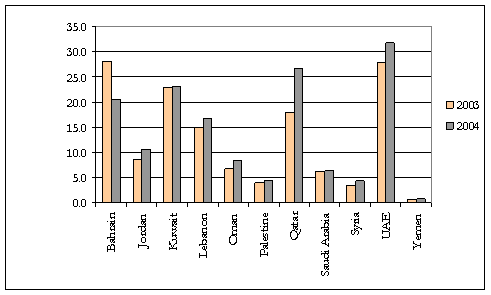
Figure
1
Number of Internet Users in West Asia
Countries
Figure 2
Number of Personal Computers in West Asia Countries

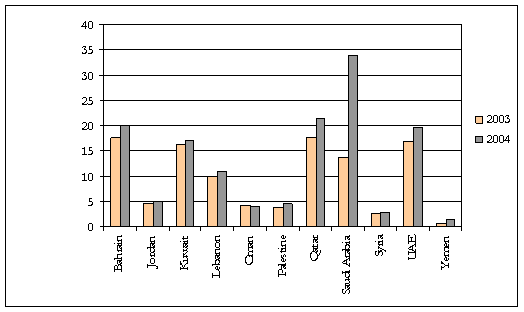
Source (Figures 1 and 2):
ESCWA Statistics Information System, 2005
Generally, all West Asia countries need to streamline data generation
and management, with an eye for efficiency and transparency. Institutional needs can be summarized
according to three levels:
(1)
At the government level, there
needs to have a coherent framework for generating data and organizing data flow
within an agency and across line agencies;
(2)
At the level of data-generating
institutions, there should be more human and financial resources to manage
increasingly larger and more complexes databases; these institutions also will need
protocols for managing, processing and disseminating environmental data; and
(3)
At the level of decision-makers,
there should be mechanisms for retrieving environmental data that have already been
interpreted to show trends, issues and options.
All countries
realize that data management should lead to improved decision-making yet few
countries have yet been able to develop and employ information systems that
support decision-making. Some promising
examples follow – in the absence of more specific information; it is too early
to call them success stories.
- Occupied
Palestinian Territories: The Palestinian
Integrated Rural Environmental Protection Plan developed a rural
information system aiming to support the actions and interventions in
rural areas. The framework was a
joint effort between the Palestinian EQA and the International Center
for Rural Environment Protection where the data is stored. The system provides up-to-date
information on various rural parameters such as socio-economic situation,
land use, nature reserves, agriculture and rangelands, water and
wastewater in rural areas.
- Oman:
The Environmental Planning and
Permits database is designed to store data and information regarding industrial
establishments. The database is
considered a success story at MRMEWR and helps the ministry plan site
visits and manage environmental permits and penalties for industries.
- Bahrain: The intended purpose
of the MAREGIS database in Bahrain
is to support decision making. In
due course, it is hoped that the database will provide answers to such
questions as: Where is the best place for an industrial development site
with the least impact on the local ecology? Which areas should be
protected to ensure protection of endangered species? The database is
expected to support applications in environmental management, fisheries
management and oil spill planning and response.
- UAE: The
coastal sensitivity atlas for oil spills developed by EAD aims to assist
old spill response teams locate vulnerable sites and make rapid decisions
that will minimize damages. The
atlas is a remarkable aid tool to oil and chemical response teams,
especially foreign teams who may be unfamiliar with the local area and
environment.
- Qatar:
The environmental site assessment and management system is a GIS-based
Decision Support System to help managers evaluate the environmental
viability of a development site. It contains fifteen different
constraining themes such as hydrogeology, urban development, fragile
landforms for the environmental evaluation of a site. It can generate automatic reports indicating
the suitability of the candidate site (suitable, moderately suitable or
unsuitable).
- Lake Maryout
DSS: System was developed by CEDARE and aims to analyze the main
policy failures behind improper urban management systems leading to
deteriorating livelihood conditions.
It is used by urban planners and environmental specialists to
measure using a set of criteria the effects of multiple stresses induced
by human activities in Lake
Maryout and to weigh
various response scenarios.
Various networks of
cooperation exist in the West Asia region;
this chapter presents a targeted selection based on information provided in the
regional reports. UNEP has already
initiated several forms of cooperation with regional organizations in the
region including AGEDI, ASCAD, CEDARE PERSGA, and , ROPMEand. These organizations have also started to
cooperate directly, thus leveraging resources and skills in key environmental
areas and regions. PERSGA is a good example of sub-regional cooperation (See
Box 2).
UNEP as part of the UN family
recognizes the need for improved cooperation and synergy among UN bodies, MEAs
and regional environmental fora, scientific and academic institutions and
networking among national and regional institutions. The Executive
Director of UNEP also felt it was necessary to put in place a more systematic
approach to international cooperation in this field, and he suggested that
Governments individually and through the Council/Forum might wish to play a
more active role in this respect. He also proposed to
the twenty third session of the Council/Forum in February 2005 the development
of an Environment Watch framework to enhance the scientific base of UNEP. The Council/Forum requested the Executive Director to further develop
the proposal in consultation with governments and other stakeholders. An updated proposal and a questionnaire was prepared and
reviewed by Governments and partners through written submissions and
consultations. The resulting
iteration of the proposal which presented the
architecture of an Environment Watch
system was considered by the UNEP Governing Council at its ninth special
session in February 2006.
In the ensuing discussion,
several representatives endorsed the need for further consultations in order to
clarify how the Environment Watch system might meet the needs of Governments
and relate to existing national, regional and global structures such as the
European Environmental Information and Observation Network, the African
Environment Information Network and the Global Earth Observation System of
Systems. Some concern was expressed at the current complexity of the system and
the need for further development to ensure that it was user‑friendly and
met the need to reduce national reporting burdens and avoid duplication.
Several representatives supported incremental development of the system,
perhaps starting with a few pilot schemes.
UNEP believes that cooperation
in the field of knowledge is a key vehicle for enhanced coherence, as shared
knowledge promotes concerted action. Within
this context UNEP is conducting regional consultations with the objective to consult with existing networks, regional bodies and
international institutions which may serve as regional, functional and thematic
focal partners in piloting the Environment Watch and to prepare a first draft
of the guidelines for piloting the information network, building on experience
from existing networks. A meeting was held in West Asia in June 2006 to Consult with relevant partners in the West Asia region so as to:
1.
Assess the situation in West
Asia with respect to
(a)
regional, national and thematic environmental
information networks.
(b)
assessment and reporting frameworks.
(c)
data and information sharing (in context of
ecoMundus).
2.
Propose an approach towards achieving better
coherency for regional and national network structures.
3.
Engage information and data providers in the
ecoMundus initiative (as a tool for networking institutions to share and
exchange environmental information and data).
4.
Identify capacity building needs with respect
to objectives 1-3.
It is to be noted
that the regional AGEDI study noted that regional environmental information systems
face the following difficulties:
1.
Poor information flow;
2.
Limited harmonization of data and
indicators;
3.
Hardware and software compatibility;
4.
Lack of funds;
5.
Intermittent commitment of
countries for cooperation; and
6.
Inadequate disclosure of information
and data sharing.
Many regional
organizations can facilitate and promote the management of regional environmental
information including:
- Council of Arab Ministers Responsible for
Environmental Affairs.
- Regional Organization for the
Protection of Marine Environment (GCC countries).
- Gulf Cooperation Council (GCC).
- Africa
Environmental Information Network (AEIN)
- Unit Nations Economic and Social Commission
for Western Asia (ESCWA).
- Center for Environment and Development
in the Arab Region and Europe (CEDARE).
- Regional Organization for the
Conservation of the Environment of the Red Sea and the Gulf
of Aden (PERSGA).
- The Arab Center
for the Studies of Arid Zones and Dry Lands (ASCAD).
- Arabian Gulf University
(AGU).
- International Center
for Agricultural Research in Dry Areas (ICARDA).
- International Development and Research
Center (IDRC) – Cairo
office.
- The Arab Network for Environment and
Development (RAED): network of Arab NGOs.
- WHO Regional Centre for Environmental Health
Activities (CEHA).
Several regional
conventions or agreements can stimulate regional collaboration for
environmental information management, including:
- Regional convention for the
Conservation of the Red Sea and Gulf of
Aden Environment (RSGA), Jeddah Convention in 1982, provides an important
basis for environmental cooperation in the Region. It was the result of a
Regional Intergovernmental Conference, supported by the United Nations
Environment Programme. Djibouti,
Egypt, Jordan, Occupied
Palestinian Territories, Saudi
Arabia, Somalia,
Sudan and Yemen
are Parties to the Jeddah Convention.
- Memorandum of Understanding between
PERSGA and UNEP in 1989 leading to the joint review of the geology of
Coral Reefs in the Red Sea, and developing the State of Marine Environment
in RSGA.
- Memorandum of Understanding between
PERSGA and UNESCO-IOC in 1991.
- Cooperation between PERSGA and ROPME
convening a conference on the sustainable use of the marine
environment. The conference
presented cross-sectoral views and experiences within the context of each
country’s progress towards sustainable development.
- Cooperation between PERSGA and CEDARE
on developing the GIS network for the Strategic Action Plan for RSGA.
- Collaboration between CEDARE, and ASCAD
under the umbrella of UNEP to set water indicators for WA countries. A set
of indicators on water quality, water and health, water and social
activities as well as other water issues has been adopted in 2004.
- Collaboration between ASCAD and ICARDA
within the Sub-regional action program to combat desertification.
- Collaboration between ASCAD and UNESCO
on the development of a water resources map for the Arab region.
- Collaboration between UNEP and it
collaborating centres in West Asia including ASCAD, Arabian Gulf University.
- Collaboration between CEDARE and UNEP
to develop the African Environmental Information System.
Illustrative regional
environmental information databases and systems, as highlighted in the national
and regional organizations reports for AGEDI study, include:
- NETWORK:
Managed by ACSAD, this integrated information system between Syria, Jordan
and Lebanon
aimed to monitor the evolution of different components of the ecological
system in the three countries.
- ASCAD is
in the process of developing an early warning system for desertification
to which remote sensing centers in the Arab region will be associated in
the form of a network, in cooperation with GTZ and the Trier University
in Germany.
- A project
is underway at ASCAD to compile information on water resources, use and
socio-economic activities in the Arab region in one database.
- The work
of the Mediterranean Action Plan (UNEP/MAP) for the standardization of sustainability
indicators between Mediterranean countries. 130 indicators have been
selected on population and society, lands and areas, economic activity and
sustainability.
- ASCAD
developed the Arab Data bank for Arid Plants (DAP) using unified data
collection forms for all countries covering nomenclature data, general
information about the plant, country information, site data, main climatic
data and topography and soil data.
The economic values of the species in grazing, medical, industrial,
ornamental and aromatic practices were considered. The system used to build the bank is
considered rather out of data and should be rebuilt and upgraded.
- ACSAD and
ICARDA joined effort to develop a regional database on sustainable water
management in West Asia, aiming to
provide all users with a dynamic source of information for member
countries on water resources management activities. An internal website was established for
data entry by the focal points. The database is hosted on the
International Plant Genetic Resources Institute (IPGRI) server.
- ASCAD also
developed the “Wadi Hydrology Network” in collaboration with the UNESCO
Cairo office and ALESCO. Both
networks aim to generate and disseminate information on management of wadi
systems in arid and semi arid zones in the Arab region.
- Priority
environmental indicators in West Asia,
and Arab Africa Regions developed UNEP, covering the areas of water,
energy, health, agriculture, biodiversity, coastal and marine environment.
- Atlas of
desert habitats in the GCC countries developed by AGU to provide
information on natural resources, biodiversity, climate and population.
- African
Environmental Information Network aiming to harness and improve access to
information on Africa’s environmental
resources.
- The Nubian
Aquifer Regional Information System (NARIS): developed by CEDARE to assist
in the management of the Nubian Sandstone aquifer providing information
about the quantity and quality of the available wells in four neighboring countries:
Egypt, Chad, Sudan
and Libya.
- CEDARE
Geographic Information System contains data on water resources, land
degradation, and urbanization. The digital maps comprise several levels of
details: the regional, the inter-country, and the national levels, as well
as the hot spots. The system has
been developed over two phases, the first – pilot- phase providing lessons
learned to expand the system in the second phase.
- CEDARE
Strategic Environment Information Systems assists environment authorities
in six Arab countries manage their environmental related information at
both the national and regional levels.
It consists of from the following databases: 1) Sustainable
development indicators information system; 2) environmental experts and
human resources database; 3) environmental institutions profile database;
4) environmental institutions activities database; and 5) bibliographic
database.
- North
Africa Environmental Web Portal developed by CEDARE in cooperation with
UNEP. It provides an easy
navigation website for environmental organizations in the North Africa
Countries.
Noteworthy
international environmental information systems include:
- GEO data portal (UNEP) feeding into the
Global Environmental Outlook assessments.
- FAOSTAT database initiated and managed
by the FAO.
- The Millennium Ecosystem Assessment
developed for the UN by collaborative institutions and agencies including
UNEP and the World Resources Institute.
- Earth Trends online portal developed
and hosted by the World Resources Institute.

There are many lessons
learned related to environmental data and information in West
Asia but they all converge into one: the need to design and
build environmental information systems that support decision-making and policy
development. Currently, only a
fraction of the available systems are used to support decision-making. The reasons for this “disconnect” between
data generation and decision-making are numerous: e.g., decision-makers are not
aware of the data, are not able to interpret it, the data is too theoretical to
support decision-making, data accessibility is inadequate, information systems
are not designed on the basis of decision making needs and do not provide the
flexibility and the products needed and suitable for policy and decision makers. Good examples of environmental information
system that support decision-making are emerging in several countries and must
be explored further, as well as expanded and replicated in other countries (see
Section 5.5). Some lessons learned follow.
·
Information systems can only
succeed if they meet user needs.
·
Donor-financed information systems
cannot generate sustainable results if the national government or counterpart
organization is not committed to follow-up and maintain the system after the
“formal” project ends.
·
Recognition of data ownership and enforcement
of copyright laws and regulations are essential ingredients for promoting data
sharing and exchange.
·
Information systems are expensive
tools if not put to use in a cost benefit fashion.
·
Host organizations (and national
governments) must commit sufficient human and financial resources to sustain
the systems.
·
Environmental information systems should
provide temporal and spatial coverage to increase effectiveness and
reliability; GIS applications are a powerful data analysis and display tool.
·
Regional environmental reporting
requires intimate partnerships and technical coordination; data systems should
be compatible and discrepancies must be addressed.
·
Better results produced when there is good
working relationship between data producers and data users
·
Using environmental information
systems to support decision-making is not easy.
This requires sound judgment, science, coordination and authority.
·
Environmental information systems
are never perfect. All systems, old and
new, can be improved through proper support and networking. Evaluation, monitoring (including independent
audits) can help identify and remedy data errors and/or deficiencies.
·
Continuous capacity building is
essential for the sustainability for environmental information systems and its
use for decision support.
·
Strong leadership and high level
political support is necessary for successful information systems. Information
system strong in technology and poor in data are of limited value. There should
be a balance systems population with data and the technology used to manage and share these data.
·
It is critical to involve/consult with decision
and lawmakers in the process of establishing any information system, as they
are the source of actions and financing. In general, involving end users in the
design phase is essential to the success of any system.
·
Collaboration with the private sector is
important as they hold significant portion of environmental data.
Thinking forward, it is opportune to recognize the
elements of the information hierarchy from environmental data and information,
to standards and indicators, to decision-support system, as illustrated clearly
in
Figure
3, with the
rapid growth of environmental data, it is very difficult to jump from data to
decision support system without first due consideration for standards and
indicators.
Figure
3
Echelons of the Information Hierarchy

8.
Recommended priority actions
A lot could be done
to improve and enhance environmental information and data in West
Asia countries. The
following recommendations covering policy, institutional, technical and
financial issues were expressed by West Asia
countries as part of the national reports submitted to AGEDI and UNEP, and the
regional consultation on the study. These
priority actions can support the formulation of a regional strategy for
environmental information. Ideally,
priority actions should seek to accomplish specific objectives at the local,
sub-national, national and/or regional levels.
Regional Level:
- Develop a regional environmental information
convention on information sharing and accessing that enhance the regional
partnership in sharing environmental information, and also help increasing
public access of environmental information at the national and regional levels.
The convention should be realistic to the reality of the region starting
with doable steps to betaken by the countries and regional entities. It
would then evolve incrementally to more advanced levels of data and
information sharing.
- Catalyze countries of the region to
have clear mandate and role for their institutions in information
development and dissemination.
- UNEP-AGEDI to provide countries with advice
and guidelines related to
environmental information policies.
National Level:
West Asia countries should individually and/or
collectively develop policies that:
- Regulate data sharing &
dissemination (including restrictions, copyright, source referencing,
etc.)
- Assign lead responsibility for data collection
and reporting by designating an existing institution or agency to serve as
the lead host for environmental information (national observatory, etc.)
- Reduce process time for data requests (setting
maximum allowable duration for data requests)
- Organize the flow of environmental information
and databases.
- Enhance public access to unrestricted data.
- Formalize the establishment of national
EIS or support existing systems (alternatively, some countries need to take
active steps to implement existing legislation that call for EIS).
- Define data categories for purposes of disclosure
with or without prior consent.
Regional Level:
- Develop regional knowledge and
information exchange mechanism among regional and international
organizations in West Asia region.
Regional working groups should be established for data and information technology.
UNEP model for environmental information networking, highlighted in the
Environment Watch Proposal should be considered as a model to be adopted at
the regional and national levels. Regional and sub-regional networks
should be considered (e.g, a network for GCC countries, and a network for
Masherq Countries). It would be most practical to consider a regional
network for the Arab Region including linking Arab countries in Africa and
West Asia, in addition to regional and
international agencies and organizations working in the region. The network
to be established under the Umbrella of the League of Arab States, lead by
UNEP in partnership with key agencies in the field of environmental
information in the region.
- UNEP-AGEDI to provide assistance to the
countries to strengthen or establish national environmental information
networks, including guidelines on how to establish those networks.
National Level:
West Asia countries need to:
- Establish national environmental
information networks, including a core focal point, steering committees, and
thematic focal points.
- Recognize the value of information in
planning and decision-making; this will provide increased incentive and
justification for setting up IT units and securing the funds to run them
- Take active steps to pool existing air
and water quality monitoring services and capabilities to ensure
continuous monitoring
- Encourage and support environmental
monitoring and reporting at the municipal level
- Integrate existing “observatories” in public
institutions to secure government funding
- Establish IT departments/units in relevant
data generating institutions including ministries
- Develop and exercise Quality Assurance
/ Quality Control protocols of environmental data
- Provide technical training to key staff
in data generating institutions (data collection, QA/QC reporting, data
processing, etc.)
- Demand and exercise increased
cooperation with international bodies to promote the transfer of technology
and know-how (north-south as well as south-south exchange)
- Promote stakeholder involvement and public
participation in data collection and management
- Institutionalize public awareness
programs to boost demand for environmental information
- Build and support public libraries
- Consider the establishment of regional information
and/or watchdog networks (for example, the “Long Term Ecological Network
in West Asia”)
- Extend national information systems to
sub-national directorates and governorates to ensure adequate geographic
coverage of the data generated (and equality in data access)
There are many
technical recommendations to improve environmental information and enhance the
flow of information nationally and regionally.
Key recommendations include:
Regional Level:
- Strengthen regional and national
capacities for environmental information development, management and
networking, with full consideration of Bali Strategic Plan for Technology
Transfer and Capacity
Building.
- To establish
or enhance national and regional environmental data collection programmes.
- Catalyze
use of standards for inter-operability standards, data and of cooperation
between the bodies, access mechanisms.
- Provide
guidelines and tools for development and use of environmental information
and indicators.
- Encourage regional initiatives, projects
or studies that build upon and integrate existing national pilot or
prototype activities.
National Level:
- IT infrastructure:
many countries in Western Asia (Level 1
and Level 2 on ESCWA’s IT infrastructure maturity scale) still have a long
way to go. Computer users and
internet connectivity need to increase markedly to partake in the
information age more efficiently.
Bandwidth must increase several folds (and keep up with ever new
breakthroughs) to reduce the digital divide with the west (improvement will
also require increased political will).
- Environmental
indicators: nearly every country in Western Asia
has developed indicators to monitor environmental performance. Unfortunately none of them are
immediately compatible with the indicators (coined “variables”) used in
the GEO Data Portal. Some of these
national indicators should therefore be realigned to be more consistent
with GEO.
- Data
format and structure: many countries acknowledge the need to develop data protocols
that will reduce discrepancies between similar data groups located in
different institutions and agencies.
Data protocols could also specify the frequency of updating.
- Data gaps:
despite the abundance of environmental data in West
Asia countries, each country continues to face crippling data
gaps (not many) that should be addressed.
It is therefore important to assist or encourage countries to
determine priority data gaps (not needs) in key environmental areas (for
example, pressures and receptors).
- QA and QC
protocols: nearly every country voiced the need to establish mechanisms to
verify the quality and reliability of the environmental information and
data. QA and QC protocols could be
developed within data-generating institutions and between
institutions (cross-validation, checking for consistency, etc.).
- Setting up
IT departments: most research institutions and agencies recognize the need
to set up IT departments/units or strengthen existing IT units. This may require a combination of
resources including human, technical and financial.
- Storage media:
although environmental information is usually generated in digital form,
old records and some new records continue to be stored using the
conventional log book method (this is especially true for
municipalities). Many
data-generating institutions need to accelerate computerization programs
and transfer all environmental data in digital format.
- Keeping IT
infrastructure up to speed: IT infrastructure is steadily improving in West Asia but at a slower pace than in other
regions. Many institutions have invested
heavily in revamping hardware and software installations but such
investments usually take too long to materialize (and new installations
may become outdated by the time they have been installed).
- User-friendly
databases: probably every country in Western Asia
has developed on-line databases (see indicative list in Table 1) but many websites contain only a fraction of the
data that is currently available. It
is important to display the full range of data categories to potential
visitors and eventually limit access by requiring login username and
password. The website should clearly distinguish classified (confidential)
from non-classified (public) data.
Financing
information systems is clearly a problem in all countries. Pertinent recommendations include:
Regional Level:
- Establishing regional environmental
information trust fund that can support the implementation of regional
environmental information projects. The aim of the projects should enhance
data and information collection programmes and enhance access to
environmental information.
- Create regional project portfolio for
environmental information projects at the national and regional level and
solicit to regional and international donors.
- Seek partnership and support of the
private sector in the region to support environmental information projects
and networks.
National Level:
- Governments need to reconsider the
allocation of annual budgets to run
IT departments and environmental information systems
- Make best use of local and
international funding (by making them mutually dependent)
- Identify new sources of funding to
finance information systems, public libraries, awareness programs and projects
- Sell information services to the
private sector to help cover financial costs (of the service)
- Make better use of international
conventions to access financial resources
APPENDIX A
Authors of National and Regional Reports
1. National Reports:
|
Country
|
National Expert/Author
|
Institution
|
|
Bahrain
|
Waleed K. Al-Zubari
|
Arabian
Gulf University
|
|
Egypt
|
Moheed Abd El-Sattar Ebrahim
|
Egyptian Environmental Affairs Agency
|
|
Jordan
|
Ahmad Thaljij Qatarneh
|
Ministry of Environment
|
|
Kuwait
|
Abdul Nabi Al-Ghadban
|
Kuwait Institute for Scientific Research
|
|
Lebanon
|
Karim El-Jisr
|
ECODIT Liban
|
|
Oman
|
Mohammed bin Saif
Al-Kalbani
|
Ministry of Regional Municipalities,
Environment and Water Resource
|
|
Occupied Palestinian
Territories
|
Naim Mahmoud Al-Khatib
|
Environmental Quality Laboratory
|
|
Qatar
|
Sayed Jamal Bukhari
Mubarak Khalifa Al-Dosari
|
Supreme Council for the Environment and
Natural Reserves
|
|
Saudi
Arabia
|
Ahsanullah Khan
|
Presidency of Meteorology and Environment
|
|
Syria
|
Yahia Awaidah
|
Consultants for Sustainable Development
|
|
UAE
|
Anil Kumar
|
Environment Agency Abu Dhabi
|
|
Yemen
|
Ahmed Salem Muskat
Jamalat
Hassan Abdo Ali Al-Aghbari
|
Planning and Data Environment Protection
Agency
Ministry of Water & Environment
Protection Authority
|
2. Regional Reports:
|
Institution
|
Author
|
|
Program for the environment of the Red Sea
and the Gulf of Aden (PERSGA)
|
Ahmed
Abdel Rehim
|
|
Center for Environment and Development in the Arab Region and Europe (CEDARE)
|
Hossam
Allam
|
|
Arabian Gulf University (AGU)
|
Mohammed
Ait Belaid
|
|
The Arab
Center for the Studies
of Arid Zones and Dry Lands (ASCAD)
|
Abdallah
Droubi
|
APPENDIX B
Tasks Included in the Terms of Reference
Task 1
Please answer the following questions:
·
What are the focus areas for
environmental data and information in your institution/ country, or region (as
applicable to your case)?
·
What is the environmental
information needs common across stakeholder groups in your country (region)?
·
Is there a national (regional)
environmental information system, initiative, programme, project, etc., that
address those needs? When it started and when it will be completed?, who is
overseeing it?
·
What are the strengths and
weaknesses of current public information systems and services provided in your
country (region)?
·
What are the preferred information
acquisition methods? Internet, CDs, printed materials, etc.
·
What are the constrains and
barriers to access environmental information in your country (region)?
·
Is there a national (regional)
programme or project on environmental indicators? Please provide titles,
starting and ending dates, thematic areas covered, indicate whether it has been
successful and why?
·
Are there any monitoring
programmes (national or regional) aiming at collecting data and filling in data
gaps, what are the thematic areas covered?
·
Does your country (region) produce
state of environment (environment outlook) reports? Please give dates produced;
what is the information sources being used in producing this report?
·
Please give recommendation to
improve public access to environmental data at the local, national and regional
levels (address the following aspects: policy, institutional, technical,
financial, sustainability).
Task
2
Please identify and provide information on
initiatives, programmes, projects, systems, or networks on environmental data
and information. You need to give the
experience of your own organization too.
For each one,
please provide the following:
- Name:
- Lead
agency:
- Purpose,
aims, objectives:
- Users:
- Methods
- a description of the work done.
- Appropriateness
of the approach.
- Institutional
capacity.
- Outcomes
and benefits expected or achieved.
- Results
(impact).
- Effectiveness
and efficiency:
- Discussion
on the results in relation to the intensions.
- Lessons
learned and experiences
Task 3
Please
synthesize all the information you collected and prepare a 12-15 page report
according to the following outline:
1-
Title.
2-
Executive summary
(no longer that one page, shorter is preferable)
3-
Introduction and
background
4-
Methodological
approach.
5-
Status of
environmental data and information.
a.
Analysis of
existing initiatives, programmes, projects, systems, and networks.
b.
Data and
information availability (collectively, sectoral and thematic)
c.
Public Access.
d.
Information policy
and legislations.
e.
Institutional capacity for managing environmental data and
information.
f.
Financing of environmental data and information.
6-
Effectiveness and
efficiency of current information systems (include strengths and weaknesses).
7-
Constrains and
barriers to manage and improve availability and accessibility of environmental
data and information.
8-
Assessment of
general requirements:
a.
Environmental priority issues.
b.
Priority
environmental information needs of various groups (stakeholders) to support
decision-making.
c.
Technological needs
d.
Institutional needs
(including training and finance)
9-
Regional and international cooperation
(including UNEP and other UN agencies).
10- Opportunities for the future.
11- Lessons learned and experiences.
12- Recommendations of priorities for action.
Please consider the following:
a.
Policy.
b.
Institutional.
c.
Technical.
d.
Financial.
e.
Sustainability.
13.
References
Appendix 1
List of agencies and person interviewed (if any).
Appendix 2
List of conventions used.
APPENDIX C
Cited
References, Websites and Consultations
AGEDI Regional
Studies:
1.
Bahrain. Prepared by Waleed K. Al Zubari from the Arabian Gulf University.
2.
Egypt: Prepared by Moheed
Abd El-Sattar Ebrahim from CEDARE.
3.
Jordan. Prepared by Ahmad Qatarneh from the Ministry
of Environment.
4.
Kuwait. Prepared by Abdul Nabi Al-Ghadban from the Kuwait
Institute for Scientific Research.
5.
Lebanon. Prepared by Karim El-Jisr from ECODIT
Liban.
6.
Oman. Prepared by Mohamed Saif Al-Kalbani from the Ministry
of Regional Municipalities, Environment and Water Resource.
7.
Occupied Palestinian Territories. Prepared by Naim Al Khatib from the Environmental
Quality Laboratory.
8.
Saudi Arabia. Prepared by Ahsanullah Khan from the Presidency
of Meteorology and Environment.
9.
Syria. Prepared by Yahia Awaidah from Consultants
for Sustainable Development.
10.
United Arab Emirates. Prepared by Environmental Research and
Wildlife Development Agency.
11.
Yemen. Prepared by Ahmad Salem Mulkat from the Planning
and Data Environment Protection Agency.
Other reports:
12.
E/ESCWA/ICTD/2005/6 (Draft), 29
August 2005: Regional Profile of the Information Society in Western
Asia (English)
13.
Convention on access to
information, public participation in decision-making, and access to justice in
environmental matters. Aarhus, Denmark
– June 25, 1998
List of Websites
Visited
http://www.agedi.info/en/index.jsp
http://www.unepgrid
www.webopedia.com
www.esis.escwa.org.lb
www.unece.org/env/pp (Aarhus Convention)
People Consulted
Juliana Daher
Research Assistant
ICT Department
ESCWA
Beirut, Lebanon
Email: daher@un.org
Zahr Bou Ghanem
Research Assistant
ICT Department
ESCWA
Beirut, Lebanon
Email: bou-ghanem@un.org
Appendix D
Glossary
of Internet Services
Dial-up
connection: Refers to connecting a device to a network via a modem and a
public telephone network. In the past, the maximum data rate with dial-up access was 56,000 bits per second, but new
technologies such as ISDN
are providing faster rates.
Broadband
connection: a high-speed Internet connection using DSL, cable, wireless,
fiber optic or satellite means of transmitting data. The terms broadband
usually refers to a high-speed network connection with data speeds in excess of
128 kilobits per second.
Integrated
Services Digital Network (ISDN): An international communications standard for
sending voice, video, and data
over digital telephone lines or normal telephone wires. ISDN supports data transfer rates of 64 Kbps (64 kilobits per
second).
Asymmetric
Digital Subscriber Line (ADSL): A new technology that allows more data
to be sent over existing copper telephone lines (POTS).
ADSL
supports data rates of from 1.5 to 9 Mbps when receiving data (known as the
downstream rate) and from 16 to 640 Kbps when sending data (known as the upstream
rate).
DSL is similar to ISDN inasmuch as both operate over existing copper
telephone lines (POTS) and both require the short runs to a central
telephone office (usually less than 20,000 feet). However, DSL offers much
higher speeds - up to 32 Mbps for upstream traffic, and from 32 Kbps to over 1 Mbps for downstream traffic.
Leased-line
connection: Unlike normal dial-up connections, a leased line is always active and affords a faster data transfer rate and is cost-effective if the Internet is
used heavily. It is typically used by businesses to connect geographically distant offices.
Wi-Fi:
Wireless Fidelity is meant to be used generically when referring of any type of
802.11 based wireless Local Area Network (LAN) products. The term is promulgated
by the Wi-Fi Alliance. It provides up to 54 Mbps in the 5GHz
band.
Frame relay
connection: A packet-switching protocol for
connecting devices on a Wide Area Network (WAN)
Field Foundation for International Enviornmental Law and Development; Principle 10 / Aarhus
Convention http://www.field.org.uk/aarhus.php
The Bali Strategic Plan (BSP) provides a coherent
implementation platform for UNEP-wide implementation as well as approaches to
strengthening national and regional institutions responsible for environmental
management, promotes the integration of environmental initiatives and
programmes agreed at the regional and sub-regional levels, provides a strategy
for strengthening technology support and promotes efficiency and effectiveness
in using financial and human resources through better coordination and
cooperation with other UN agencies, MEAs and sustainable development
programmes. The plan was adopted by the High-level Open-ended Intergovernmental
Working Group on an Intergovernmental Strategic Plan for Technology Support and
Capacity‑building at its third session, in Bali, Indonesia, on 4 December
2004.